Movies I Actually Love, Part I

I have mentioned time and again how much I dislike cinema. It pretends to be art but almost always fails to live up to the claim. As entertainment, it is too authoritarian for my taste. There are, however, several films that I love and consider to be as close to works of art as any movies can be. Here they are in no particular order.

1. Before Almodovar sold himself out to Hollywood and started churning out idiotic tear-jerkers of the Hable con ella and Todo sobre mi madre variety, he was actually a great movie-maker. What Have I Done to Deserve This? (1984) is, in my opinion, his greatest work. Every frame, every move of every actor, every single word are absolutely amazing. I really wish we could have the early Almodovar back, but obviously that’s not going to happen.
2. Before Javier Bardem sold himself out to Hollywood and became the new favorite lap dog of the egregiously untalented Penelope Cruz, he was one of the most gifted actors of his generation. Mondays in the Sun (2002) is so professionally and beautifully made and Bardem is so incredibly good in it that I can’t stop watching this film. I’m now on my second DVD because I watched the first one so many times that it became useless.
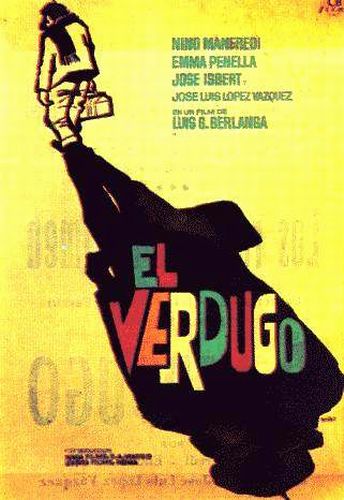
3. El verdugo (1963) or Executioner by Luis Garcia Berlanga is a classic of Spanish cinema. It is a very quiet, low-key portrayal of how easily and casually one can slip into performing acts of atrocity in the most mundane way possible. In many ways, this film is very symbolic of what the entire XXth century has been like.
4. In case you think I only like Spanish-language movies, you are wrong. Crash (1996) by David Cronenberg (not to be confused with a 2004 film by the same name) is a brilliant movie. It has been criticized by prissy viewers and film critics. Nevertheless, it is one of the most insightful cinematic analyses of sexuality that I have ever seen. The movie’s tone is subdued to the point of being flat which is precisely what makes it standout against the background of regular Hollywood concoctions that attempt to deal with sex. Hollywood film-makers and audiences are so terrified of sexuality that they talk, cry, babble and prattle it to death.
5. As I said many times before, nobody knew how to make movies like the Russians. It’s very difficult to choose one film that I consider to be the best among the incredible production of the Soviet filmmakers. I guess, Unfinished Piece for the Player Piano (1978) has got to be the winner from the Soviet epoch. The film is based on a play by Anton Chekhov. Chekhov is obviously a genius and making a film based on his work is a huge challenge. Nikita Mikhalkov, the director, used to be so good that he created a version of Chekhov which is better than the original. This is also the only film where Mikhalkov delivers a great performance as an actor. (His acting talents are extremely limited but here he was really good.) Forget about the plot of this movie, just observe how beautifully the director creates the ambiance. The actors are phenomenal, as usual in Soviet movies.
6. From the post-Soviet era, I recommend Heart of a Dog (1988). This movie is based on a novel by one of the greatest Russian writers of the XXth century, Mikhail Bulgakov. Once again, as amazing as the novel is, the film manages to be almost as good. Unlike the previous movie I listed here, I don’t think this one exists with English subtitles. Which is a shame because non-Russian movie-lovers are losing out on something huge here.
(To be continued. . .)

>So Has the Movie Atlas Shrugged Already Been Released?

>

And if so, then why isn’t it showing at our local movie theater? I haven’t been able to find it anywhere in St. Louis either. I absolutely need to watch this movie, people. Even if I have to schlep all the way to Springfield. And yes, I’m sure that the book must have been mangled horribly in the course of making the movie, but still I have to see it for myself.
Has anybody seen it? Any impressions to share?

>Why I Don’t Like the Movie The Lives of Others

>http://rcm.amazon.com/e/cm?t=clasblo-20&o=1&p=8&l=bpl&asins=B000OVLBGC&fc1=000000&IS2=1&lt1=_blank&m=amazon&lc1=0000FF&bc1=000000&bg1=FFFFFF&f=ifr

I know that most people adore The Lives of Others and find this movie very touching. I, however, could never get into it because of how wrong it gets many of the most basic details of the characters’ daily existence. I don’t like Cold War rhetoric and imagery because of how reductive and unintelligent they are. It’s always the good versus the evil, and it doesn’t matter which side of the Iron Curtain you are on. The verbiage is the same and the desire to reduce complex realities to a bunch of cheesy stereotypes is omnipresent. Both sides judge each other according to their own, very limited ideology, without ever trying to understand that things might be a little bit more complex.
During the Soviet times, my father always listened to the BBC (secretly, of course) at night. “They are fools, all Westerners are fools,” he would fume in the morning. “Last night they said that there were human rights abuses in the USSR which consisted of people not being allowed to travel freely abroad. They have no idea about who we are and how we live. I have a PhD in linguistics and I have to leave aside my research and spend the entire next week sorting rotten cabbage. But, sure, not being able to travel abroad is my main concern.”
I was reminded of this reductive Cold War mentality as I was watching The Lives of Others. The filmmakers so obviously made their film with the goal of selling it to Americans that it was painful to watch. Take, for example, that scene where the character who works for the Stasi comes to his BARE apartment, where he lives ALONE, eates a plate of spaghetti with KETCHUP and invites a PROSTITUTE over to his apartment. I mean, how much more ridiculous than that can you get? And, of course, if a movie is so careless with the minor details, how can you expect it to deliver anything more reliable in terms of the big picture? The result is this unbearably cheesy Americanized fantasy about what life behind the Berlin Wall was like. A fantasy that has nothing to do with reality.

>Mondays in the Sun

>Mondays in the Sun is my favorite movie in the entire world. I watched it a dozen  http://rcm.amazon.com/e/cm?lt1=_blank&bc1=000000&IS2=1&bg1=FFFFFF&fc1=000000&lc1=0000FF&t=clasblo-20&o=1&p=8&l=as1&m=amazon&f=ifr&md=10FE9736YVPPT7A0FBG2&asins=B001DN0UY4 times already and still want to watch it again and again. It starts the incredibly gifted Javier Bardem before he sold out to Hollywood and became the silly Penelope Cruz’s plaything of the month.
This film is not the typical Hollywood-style face-in-a-cake happy-ending fare. Mondays in the Sun is a very profound and realistic portrayal of the lives of laid-off shipyard workers in Spain and the ways in which unemployment damages their male identity. This amazing film is a reminder that movies don’t have to be just one more brainless and tasteless kind of mass entertainment. It is still possible to make films that are works of art.

Every actor in this film plays beautifully and poignantly. The economy of artistic means is impressive. There are no stupid special effects, no excessive sentimentality that kills most Hollywood productions. Altogether, this is simply an incredibly well-made work of cinematographic art.

>What’s Feminist about Steel Magnolias?

>

Yesterday I felt absolutely exhasuted after all my classes and meetings. So I felt like spending the evening watching some good old feminist classic by way of relaxation. http://rcm.amazon.com/e/cm?lt1=_blank&bc1=000000&IS2=1&bg1=FFFFFF&fc1=000000&lc1=0000FF&t=clasblo-20&o=1&p=8&l=as1&m=amazon&f=ifr&md=10FE9736YVPPT7A0FBG2&asins=B00004TJKK
was on, so I decided to watch it because I always heard people refer to it as a profoundly feminist film. It is also a perennial staple of “Feminist Film” courses.

Boy, was I in for a disappointment! This poorly made, boring flick is nothing if not profoundly patriarchal. The main story line revolves around a young woman who is willing to risk her life and die (which happens in the end) in order to produce a baby. Because the central goal of a woman’s life is to make babies. Unless you can fulfill this goal, you are incomplete. So of course, the only reasonable thing to do is for a woman literally to kill herself in an attempt to produce a baby.

There are many other female characters who are mainly dedicated to endless hen-like clucking around the protagonist’s attempts to have a baby, as well as interminable conversations about hair-styles, weddings, husbands, etc.

Since the movie was excruciatingly boring, I started investigating the reasons for why some people see this patriarchal piece of rubbish as a feminist film par excellence. The only reason offered by the scholarly articles I encountered on the subject is that the movie “celebrates female camaraderie.” This is a very weird understanding of feminism. Female friendships are great but the film is obviously not about that. In Steel Magnolias, we see women of all generations inhabiting a world of their own. It’s a world of babies, beauty, and homemaking. It’s a world of things that the patriarchal societies always mark as exclusively female. Men are supposed to be detached from these “womanly” interests and concerns, while women have no interest in the pursuits of men. The view of genders as profoundly divided by an unbridgeable chasm of difference is patriarchal. There is nothing feminist about it. Just as there is nothing feminist about this silly movie.