Book Notes: The Psychoanalyst Sequel

Remember the novel The Psychoanalyst by John Katzenbach I recently posted about? The one that has two sequels only available in Spanish for a reason nobody knows?

I read the first sequel in Spanish, and it’s definitely a translation. There are some expressions that are calques from English and don’t exist in Spanish. The author is definitely American.

The sequel is good. These novels sold millions of copies in the Spanish-speaking world. But something mysterious is going on with these books. I bought this novel on Kindle but then the Kindle version disappeared from Amazon. Even the page no longer exists. It’s so weird.

The reason I like the novel is that the superhero protagonist is a bookish man in his fifties. He’s 53 in the first novel, 58 in the second, and 68 in the third. And the decisive, hardcore woman who saves everybody in the second book is 87.

I’m now reading the third book in the series that was published last year. Again, it’s only available in Spanish. This is a literary mystery, and I found no explanation for it anywhere.

The Devastating Consequences Are Here

Being groped and hair-sniffed while you are grieving a terrible loss is devastating enough but I thought the devastating consequences upon Navalny’s murder were promised to his killers, not his family members.

The Destructive Intelligentsia

Another quote from John Gray:

Parallels between late nineteenth- and early twentieth-century Russia and the early twenty-first-century West may seem far-fetched. Their histories are very different. . . Liberalism did not die in Russia. It was never born. Yet the similarities are real. Late tsarism and the late liberal West produced an intelligentsia that attacked the society that nurtured them. Both were under attack from within.

Gray, John. The New Leviathans: Thoughts After Liberalism (p. 57). Farrar, Straus and Giroux. Kindle Edition.

There is a real difference, though. The intelligentsia of the Tsarist Russian Empire saw terrible things in the society it demolished. A police state. The absolutely horrid and subhuman existence of the peasantry. The Pale of Settlement and pogroms, which impacted the many Jewish intellectuals personally. The destruction of the non-Russian languages, which impacted the many Ukrainian intellectuals personally.

Life was. . . maybe not particularly short in comparison with other countries but definitely nasty and brutish. The Tsarist intelligentsia was rebelling against a state that was vastly inferior to the American, British, or French states of that time. Anybody who was not a complete animal or a congenital moron supported the revolution against the Tsarist regime.

The Western intelligentsia is in a very different situation. Their problems are pinpricks in comparison. They enjoy the best conditions for intellectual pursuits ever known to humanity by far. Their society truly nurtures them. The Tsarist intelligentsia ended up creating an absolute horror with their revolution but these intellectuals had never been nurtured like today’s Western ones are.

Now we know that Tsarism was definitely better than Stalinism or even Brezhnevism. But at least those intellectuals destroyed their society for a reason. It doesn’t make anything better or bring back any of the victims but at least you can kind of sympathize with it.

So I get Gray’s analogy but it’s not altogether correct.

A Bad Analogy

And that’s why Lebanon is such a beacon of peace and prosperity as a result.

Oh, wait…

Transactional Love

There’s a video of a woman who explains why relationships fail. You ask your boyfriend to exchange morning texts, he agrees, but soon forgets. You remind him but he forgets again. And then you stop liking him, and the relationship ends.

The video went viral because people intuit that something is wrong but can’t put it in words. It’s the marketization of love that bothers them. In the video’s definition of love, it’s no longer a feeling that you experience. It’s no longer the romantic love, the overpowering emotion that changes everything. It’s no longer the love as we have understood it in our civilization since the 12th century. It’s now a transaction. You give me XYZ and I give you “love” in return.

The interesting thing is that what’s being exchanged in this transaction isn’t real. It’s a simulacrum, an empty sign. The morning texts are supposed to mean that the boyfriend cares. But they don’t really mean it because they aren’t a spontaneous expression of his feelings. If he wakes up in the morning, and you are the first thing he thinks about, and he’s filled with joy and expresses it in a text message, that’s beautiful, and it does mean something. But if he only does it as a chore, then the texts are meaningless. The woman wants to purchase something completely worthless and give something equally worthless in return.

Transactional love is an exchange of simulacra. He offers a fake sign of caring, and she gives fake love in return. Actual love is scary. You can’t squeeze it into a formula of transaction, of supply and demand. It can’t be quantified or explained with graphs and arrows like the woman does in the video.

We are so afraid of life that we hide from it among empty signs, primitive formulas, and barren equations. Transactional love is no love at all.

The Problem of Europe

What a terrible tragedy. You have the whole problem at the heart of today’s Europe right there.

The New Leviathans

I’m reading John Gray’s The New Leviathans. Thank you for the recommendation, reader Cliff Arroyo. I’m loving it. I don’t believe I will necessarily agree with everything (because I never do and what would be the point?) but it’s a narcotically pleasant reading. Here’s a quote:

The fall of Soviet communism and the shift to a market economy in China began an era of delusion in the West. Where markets spread, freedom would follow. A new world order would replace the anarchy of sovereign states. This was the theory of globalization, a mix of dubious economic theory with millennial political fantasies.

A stupid, stupid theory that we are paying for through the nose. Russia was allowed to keep its nukes and was feted and coddled because it had “free markets” and “elections.” Now we are seeing that freedom doesn’t come from markets. It comes from people. If people don’t want freedom, nothing can make them try to be free.

I’m 19 pages into the book, and already it’s giving me more food for thought than anything I’ve read in months.

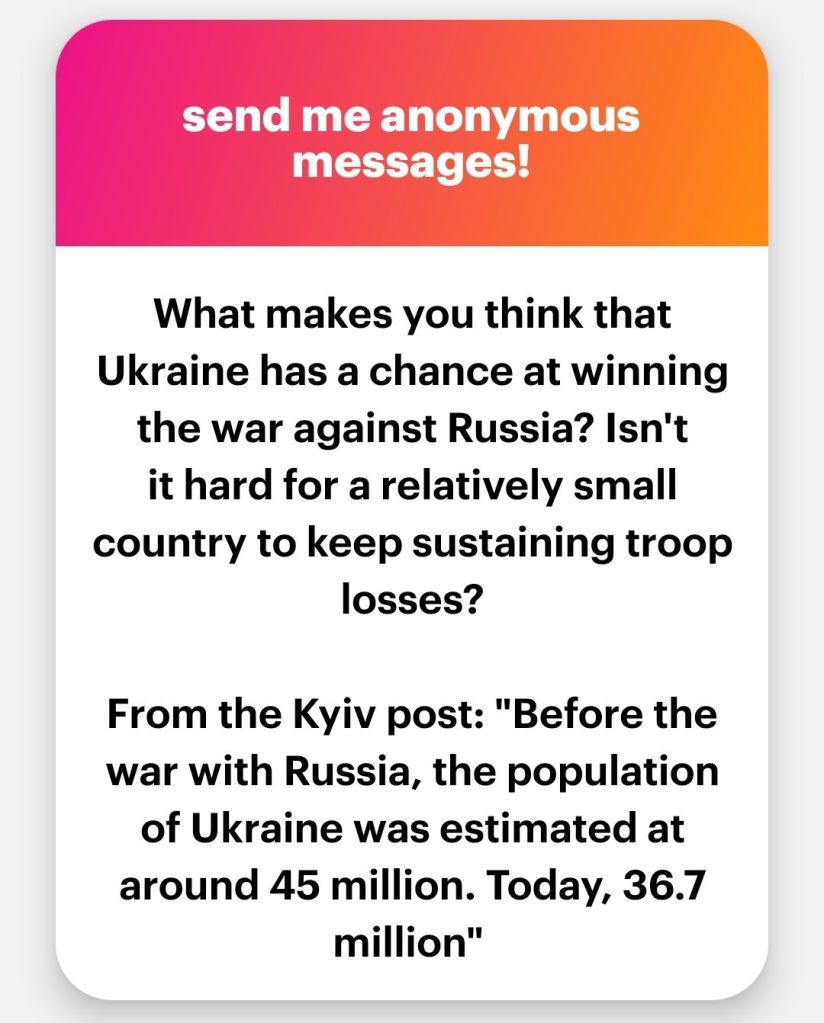
Anonymous Questions

You are in luck, my dear friend. I’m reading a great book on romanticism, and a post on the subject is coming up soon.

As a reader, I’m most heavily into novels. Short stories aren’t easy for me because I usually take a while to get into a text, and with a short story collection, I have to go through this process many times in a row, and it’s tiresome.

Reading plays is an art of itself. Plays are written for performance, not reading, so you have to pay a lot of attention to everything or you won’t get it. I have published a total of one article about a play and nothing at all about short stories. Otherwise, it’s all novels.

I usually do bullet journaling these days. My daughter and I decorate our journals as a favorite shared ritual. It’s like a form of meditation, very relaxing.

But when I’m in a midst of a very busy stretch, like right now, I do revert to productivity planners. This is the one I’m using right now:

It covers 3 months, which is perfect for a short burst of productivity. Right now, I’m teaching more than usual, substituting the lab director who’s on sabbatical, putting in paperwork for a new ASL Minor, writing a book, making endless changes to the Ukrainian book, plus I have 3 articles that were returned with (thankfully, not extensive) changes, writing a new article, and writing a conference talk. This is heavy even by my standards, so meticulous planning is unavoidable. Thanks to my productivity planner, I don’t work in the evenings or on weekends. I also take a day off every couple of weeks just to hang out and do nothing. If you don’t keep work at bay, it will seep over your entire life, and that’s not good.

The Lorca Seminar

The seminar on Lorca that I attended had 3 speakers. Two British and one Ukrainian. Two were woke and one was very interesting. I’ll let you guess which were which.

The audience was entirely Ukrainian, and it was a total trip to hear Ukrainians speak Spanish. It never happened to me before.

The talk on Lorca in Ukraine was fascinating. I found out that there was a huge Lorca debate in the country between the translators who turned the poet into a Ukrainian folk artist, simplifying the imagery, changing the meter to the Ukrainian folk song meter, and removing the surrealist, experimental stuff and the opposing group of translators who objected to this approach.

I also discovered that one of my favorite Ukrainian novels from the 1960s was inspired by and references Lorca’s poetry. To my shame, I never noticed it.

Diversity Statements in Hiring

Our university has abolished diversity statements in hiring. Not that I ever required them for my department, and policy be damned, but now they are officially gone. Exactly zero people objected.

The tide has turned. Wokeness is dying. Remember, it always begins and ends on campuses.