False Feminist Issues Versus Genuinely Feminist Issues, Part II

False feminist issues (continued):

– “Women are conditioned to please.” Everything I have seen in life has led me to conclude that men are the ones who are conditioned to please women. However, I realize that I should not be projecting my own very limited experiences onto an entire gender. If anybody is conditioned to do anything here, it’s me. I was brought up in a way that makes me see men who strive to please and not see men who don’t. In reality, however, this is not a gender issue, but, rather, a matter of individual psychology. I blogged about it before and don’t want to repeat myself too much.

If people have more false feminist concerns, feel free to mention them. Now, for the list of really important tasks that feminism still has to accomplish.

Genuine feminist issues:

The right to manage one’s own body as one sees fit. This is a core feminist issue. The only actual differences between men and women can be found (not always, but in the majority of cases) in their physiology. And until this physiology is under the complete control of every individual possessing it, there can be no discussion of gender equality. This is not only about abortion, even though the right to an abortion is absolutely crucial. There are other important issues, too, such as, for example, the very inadequate nature of male contraceptives. Is there even anything there, aside from condoms and sterilization? This isn’t good enough.

 Equal rights and equal responsibility parenting. Until taking care of children stops being the exclusive purview of women, we cannot hope for any gender equality. Maternity and paternity leaves of equal duration need to be legislated. Shared custody of children should become the norm and be awarded in the absolute majority of cases. All of us, men and women alike, will have to work hard to change our mentality and stop seeing children as some sort of an appendage to their mother with the father being expendable.

– Gender stereotypes need to go. There is still way too much of this “women (men) are, think, want, feel” crap going on. There is such a huge demand for these tired old gender stereotypes and for the discourse of “hardwired gender differences” that all legitimate research is vitiated and forced to serve the goal of selling more copies of tabloids. (Read Cordelia Fine on the subject, people. If you don’t have time for an entire book right now, the read Janet Bing’s article “Brain Sex.” When you do, I promise you will not want to talk about gender hard-wiring in the brain any more.)

(To be continued. . . )

False Feminist Issues Versus Genuinely Feminist Issues, Part I

Before I begin, I want to remind everybody that when I speak of feminism, I refer to a system of beliefs and a form of political activism arising from the idea that one’s physiological characteristics need not be invested with meaning. Simply put, feminism is about making sure that the shape of our genitals does not translate into the roles we are assigned in our personal, professional, intellectual, political, etc. endeavors.

One of the main dangers to feminism nowadays is, in my opinion, the frequency with which people label as feminist aspects of existence that have nothing to do with gender roles or gender expectations. Many people seem to think that feminism exists to make their lives better in every possible aspect and when it fails to do so, condemn it as a failed ideological project. It makes as much sense, however, to expect feminism to achieve anything other than what falls under its purview, as it is to expect a Kindle to do your dishes for you.

In this post, I want to provide a list of issues that often receive the label of feminist concerns but that have nothing to do with feminism. Then, I will offer a list of what I consider to be genuine feminist concerns. This is a work in progress, so feel free to add to both lists.

False feminist issues:

“The impossible standard of beauty.” Beauty is supposed to be quite impossible, otherwise it wouldn’t be beauty. My appearance, which is as common as pickled cucumbers in my country, has been referred as “exotic” in many places I have visited. Beauty is supposed to be hard to achieve, difficult to find, special, rare. It’s frustrating as hell that we can’t all consider ourselves and each other beautiful. But it’s not a gender issue. It’s as hard to look as Brad Pitt as it is as Angelina Jolie. Female and male models in magazines all have the kinds of bodies that cannot be encountered in nature. It can be extremely frustrating to see those impossibly skinny, ripped, flawless bodies on the screen and on billboards. To suggest, however, that it is more frustrating to all women than it is to all men makes absolutely no sense.  (Research shows that I’m right and that body image issues have no gender.)

“There is a system in place in our society that uniformly oppresses all women (men) and benefits all men (women).” There is a very large group of people who confuse gender wars with feminism or men’s rights activism. In reality, however, their engagement with gender is neither political nor philosophical. It’s always strictly personal. Such people have been hurt by a man (many men) or a woman (many women) and are now analyzing societal issues through the lens of their personal hurt. (See a very vivid example discussed here). I believe that no patriarchal ogre is quite as damaging to the cause of feminism as these gender war champions.

– “We need to promote women’s right to choose any lifestyle they wish.” As we all know, I detest “choice feminism” and see it as profoundly anti-feminist in nature. “Choice feminism” promotes the idea that women are such saintly creatures who exist outside of societies, ideologies, family structures, etc. that every single choice these infallible individuals make should be celebrated. If you question any kind of a choice made by any woman, you are an anti-feminist. This kind of respect for any choice they might make is, of course, not extended to men, which makes “choice feminism” a movement that reinforces gender boundaries.

– “Women are told to be skinny and are fat-shamed!” Once again, as annoying as this phenomenon is, it has nothing to do with gender. The fascination with thinness is very recent historically and very culture-specific. A society values what is scarce. This means that a society that routinely overeats will value thinness for the same reasons that, until very recently, my society (I’m from Ukraine, in case you don’t know) valued plumpness after surviving horrible famines. I don’t think that anybody can reasonably argue that all fat men have things easier than all fat women. Not only is this not a feminist concern, it is also not an issue that anybody can do anything about until the majority of our population becomes thin.

(To be continued. . .)

Should You Be Able to Keep a Person’s Name After a Divorce?

I think we should try to enliven the first week of the new year with a debate. Here is a fascinating question I found:

Women often debate whether to take their husband’s last name upon marriage.

Shouldn’t men have a right to ask for it back upon divorce?

I’m serious. If a woman doesn’t want to be married to a guy anymore, why should she be allowed to keep his last name? It wasn’t hers before they married.

I’m sure everybody knows what my opinion is, right? 🙂 For me, both people who relinquish their names upon marriage to mark themselves as some sort of an object belonging to their new lord and master and people who want to bear the last name of somebody who is out of their life are incomprehensible, weird creatures.

Come to think of it, the situation of these name-changers is especially ridiculous upon divorce. I’m a divorced person myself and I can’t really imagine wanting to introduce myself with my ex-husband’s last name to people. It would be the same as saying, “This man wants nothing to do with me but I’m still his possession. I won’t let him shake me off until some new guy picks me up and brands me as his acquisition.” Bleh.

Of course, having my ex-husband strut around with my last name would be even more bizarre. If I divorced him, it means I had become disappointed in his personal qualities and arrived at a conclusion that he is a shitty human being. I wouldn’t want to entrust said shitty human being with my name. God knows what weird things he might undertake while hiding under it. Then he moves on to the next owner, and I’m stuck with a last name he’s tarnished.

I think the best solution to the entire issue would be to have the courts decide which of the ex-spouses gets to keep the custody of their formerly shared last name. This would make both participants in the weird name-shedding ritual think twice before they choose to reaffirm patriarchal values in this bizarre way.

What do you think?

Gender Issues in Our Lives: A Semi-Open Thread

Reader Titfortat posed a very interesting question that, in my opinion, deserves a separate thread:

I’m curious if any of the theorists in magic land actually encounter even 1 tenth of the nasty gender stuff they claim happens out in the real world?? That question goes out to both male and female that inhabit Clarissa’s fine blog.

In my own life, I can say that it took me years of very painful struggles to get rid of gender conditioning that was undermining my existence in a variety of ways. In grad school, I remember lying on my bed trying to read a book in preparation for the comprehensive exams, and in the meanwhile, this nasty voice in my head kept reminding me that reading was not what a woman should be doing and that it made me a total loser as a woman to be doing that.

There were forced public gynecological exams I had to undergo as a child since the age of 11 (Soviet Union, everybody). I had to get married when I didn’t want to in the least because good girls didn’t shame their families by having long-term boyfriends, they got married. I’ve been pawed, harassed and beaten in the street by men who didn’t accept a “no” (Ukraine, people). I’ve been fired from a teaching position for being “too pretty” (Montreal, folks). I’ve been offered a lesser salary than male colleagues with lesser qualifications for the same job. I’ve been told more times than I can remember that I’m not a real woman, I’m a man, I have something seriously wrong with me for wanting to have a career, for not being interested in finding a husband to keep me, for paying my own way, for liking to read, for liking my job. Every single time I heard this, it came out of a woman’s mouth. I’ve had male colleagues suggest that my good grades, my publications, my grants were all a product of me sleeping with both male and female professors. I’ve been slut-shamed by female friends many many times.

Still, the hardest part was getting rid of my own inner gender conditioning, learning to accept all the ways in which I didn’t conform to the gender stereotypes of what a woman should be like. I think I managed to do it, and it has been such a relief to shed the burden of gender expectations.

So this is my story. Please share yours.

I’ll make this post sticky for a while, so that people can share their own stories of how gender stereotypes, roles, conflicts and issues hurt them in their lives. Scroll down for new posts.

Please remember that I’m not looking for statistics on what happens in New Zealand or wherever. This is a thread where we share personal stories. Anonymity is welcome.

Feminists Who Practice Gender Discrimination

You know what annoys me more than I can express? You can be a person who is only interested in attaching yourself to some guy, becoming his maid and mostly bored sexual partner, you can happily dilute your identity in his completely, even give up your name for him, live as his kept toy, abandon your career to serve his needs (I can give links but do I really need to?), and still call yourself a feminist IF you happen to have a vagina.

At the same time, you can dedicate your life to activism on behalf of gender equality, work hard to maintain the principles of equality in your life, acquaint yourself with feminist theory and improve daily upon its practice but your right to call yourself a feminist will still be disputed IF you happen to have a penis.

And the most hilarious thing of all? The people who award the title of a feminist or withdraw it on the basis of the shape of one’s genitals don’t see a problem with calling themselves feminists. They engage in blatant gender discrimination but see their own feminism as holier-than-thou.

This is precisely the reason why radical feminists often exhibit vicious hatred towards transgender people. In their neatly ordered universe of “penis=male=bad” and “vagina=female=good”, complexities of gender identifications serve as a disruptive, destabilizing force that – oh, horror! – might require one to question the gender binary. And who needs to go to all that trouble when you can simplify your life so much by analyzing the world through the male / female lens?

The entire point of feminism is supposed to be that vaginas and penises should not have meanings assigned to them. (Except, of course, the very individual, personal meaning one might or might not choose to assign to her or his own genitals.) And here come these pseudo-feminists whose entire worldview is based on the difference between penises and vaginas and who do nothing but invent new meanings for these organs.

Seriously, with such friends, feminism needs no enemies.

On Hugo Schwyzer’s Resignation from the Good Men Project

I think that resigning from the GMP was a very positive and redeeming act on the part of Hugo. After its founder, Tom Matlack, published his supremely inane post that pushed the “Men are from Mars, Women are from Venus” ideology, no self-respecting individual could remain part of the project. I declared the GMP officially dead the moment I saw that ridiculous piece, and it seems like Hugo Schwyzer felt the same.

My new-found hope that the most famous male feminist in the country was not beyond redemption, however, faded pretty soon. In a post explaining his resignation from the GMP, Hugo Schwyzer just couldn’t help displaying his trademark condescension to women. I know this is a longish quote (even after I pared it down somewhat) but please try to read it in full. This quote from Hugo Schwyzer’s post is crucial because it allows us to see very clearly why feminism has run into such an hopeless dead-end:

Seemingly innocuous words often have a profound charge depending on how and by whom they’re used.  . . What many men fail to understand is that accusing a woman of being insane or of engaging in reprisals merely because she’s expressing forceful disagreement has an equivalent ugliness. . . All of this behavior reflects two things: men’s genuine fear of being challenged and confronted, and the persistence of the stereotype of feminists as being aggressive, wrathful,  “man-bashers.”  The painful thing about all this, of course, is that no man is in any real physical danger on the internet— or even in real life — from feminists.  . .

There’s a conscious purpose to this sort of behavior.  Joking about getting pelted (or putting on the football helmet) sends a message to women in the classroom – and online: “Tone it down.  Take care of the men and their feelings.  Don’t scare them off, because too much impassioned feminism is scary for guys.”  And you know, as exasperating as it is, this kind of silencing language almost always works. Time and again, I’ve seen it work to silence women in the classroom, or at least cause them to worry about how to phrase things “just right” so as to protect the guys and their feelings.  It’s a key anti-feminist strategy, even if that isn’t the actual intent of the men doing it — it forces women to become conscious caretakers of their male peers by subduing their own frustration and anger.   It reminds young women that they should strive to avoid being one of those “angry feminists” who (literally) scares men off and drives them away.

My regular readers probably know me well enough to realize why this quote bugs me so much. Hugo Schwyzer describes a phenomenon that definitely exists and that deserves to be discussed and analyzed. And then he immediately destroys his entire argument by saying that this anti-feminist strategy “forces women to become conscious caretakers of their male peers by subduing their own frustration and anger” [emphasis mine].  And this makes absolutely no sense.

At the very beginning of this long quote, Hugo Schwyzer recognizes that one should be very careful with words. By the end of it, however, he demonstrates that he has no interest in exercising such care. A woman cannot be “forced” to do anything by some silly strategy. Agreeing to become “a conscious caretaker of male peers” is always a choice. And that choice brings certain rewards at the same time as it exacts a certain price. I’m saying this as a woman who has never subdued her rage to placate men* and can’t say that her life has been in any way thwarted by that decision.

Another problem with this argument is that the silencing strategy Hugo Schwyzer describes has nothing to do with gender. Once again, it is a dud, an issue that is not related to gender in any manner but that masks as a feminist concern in order to distract us from true feminist concerns. Using gender stereotypes to silence people works extremely well on both men and women. Let’s not forget that in the patriarchal mentality, men are supposed to take care of and provide for women. As my favorite Russian blogger says, “The only goal of a man’s existence is to solve a woman’s problems and make her life easier.” How difficult do you think it is to bully into complete and utter silence a man who is at least somewhat in thrall to patriarchal stereotypes?

And if said hypothetical man allows himself to be bullied into silence by these stereotypes, that will be his conscious choice and he will get a pay-out for doing so. Just like a woman does when she chooses to shut up in order to be considered “a good girl.” See? Not a gender issue.

There is a very interesting discussion that could have happened here about the strategies we use to manipulate and silence our interlocutors. Sadly, Hugo Schwyzer’s overpowering need to see women as perennial victims and men as victimizers has gotten the best of him yet again.

I’ve been wondering for a while why Hugo Schwyzer is so haunted by this desire to see women as weak and helpless and men as powerful and in control in every single situation. After I read his post about one of his marriages, the answer became clear to me. Hugo Schwyzer has a history of being extremely disempowered in his relationships with women**. In his pseudo-feminist writings, he creates a universe were women are powerless and he can finally feel like a savior of weak and pathetic damsels.

* In the spirit of full disclosure: I have done so to placate women. And that was a conscious choice on my part. It would be very easy for me to blame this decision on my cultural conditioning and upbringing. If I were to do so, however, I would not be honest. This was always my own choice. 

** Just read the post. Even if only 10% of it is true, I will never stop feeling sorry for a person who has been treated in such a horrific and shameless way by a manipulative and nasty partner.
Ukrainian Feminists Are Brutalized in Byelorussia

There is this very scandalous group of Ukrainian feminists called FEMEN (I blogged about it here) that uses some very strange means to promote feminism. For some reason, women who belong to this organization believe it’s a good idea to run around half naked in support of feminism. I think they are clueless and their activism is counterproductive. However, now is the moment to stand in solidarity with these activists because they have been subjected to really horrible treatment by anti-feminist fanatics in Byelorussia. I’m not seeing any articles on this subject in the feminist blogosphere, which is why I decided to write about it and share what has been happening to feminists in Byelorussia.

Byelorussia is one of the former republics of the Soviet Union. It suffered horribly during World War II. I think it was probably the area of the USSR that sustained the greatest damage during the war. When the Chernobyl catastrophe took place, the wind blew most of the radiation towards Byelorussia. The entire population has been affected by the nuclear tragedy.

As if all this suffering wasn’t enough, this miserable republic has been cursed with a dictator of well-known fascist leanings. Since 1994, Lukashenko, a great admirer of Hitler, has ruled Byelorussia. International observers state that there has never been a single even marginally fair election in the country. Candidates who tried to run against the dictator have been brutalized by the police and arrested. Journalists who tried to publish even mild criticisms of Lukashenko have been found murdered. Or not found at all.

The Ukrainian feminists went to Byelorussia on Monday to protest the mistreatment of the country’s numerous political prisoners. After they conducted their peaceful protest, they left and headed to the bus station to take a bus home. There, they were approached by a group of men (it is obvious from a variety of details that these men worked for the Byelorussian KGB), taken into the woods, stripped naked, and beaten. Then, the attackers cut off their hair and doused them with a sticky bright green substance that is very hard to remove and that leaves long-lasting stains. After that, the women were feathered. They were forced to hold slogans with swastikas. All of this was recorded with a camcorder.

After the Ukrainian feminists made their ordeal public, the leader of the Byelorussian KGB stated that “they react to everything like women” and refused to take the matter seriously.

I have noticed that my posts about the violations of human rights in the FSU are very unpopular. I understand that the reason why people don’t want to read them is not indifference. It is, rather, a sense of impotence. Nobody knows how the situation can be helped. I believe, however, that knowledge and awareness are the best – and the only – ways to help. If people in other countries know what’s going on, if they are aware of the facts, they are already doing a lot.

Sorry for spoiling the pre-Christmas mood, but this is important. I was going to promise only to write about happy things during the Christmas festivities, but there is another huge protest against the Putin regime planned in Moscow for tomorrow and I can’t avoid blogging about that.

Passive Voice Feminism

I know that everybody must be sick and tired of my rantings about the excessive use of the passive voice in feminist writing. This is an important topic, though. Just like #OWS protesters, many feminist writers suffer from addressing vague complaints to unidentified sources of aggravation and this undermines any hope for productive activism. Take the following excerpt, for example:

I wear makeup. Not much — unobservant people would call me a non-makeup wearer — but enough to cover the “imperfections” and make my lips and cheeks a bit more rosier than they were when I woke up? Why do I do this? Generally I’m treated better when I look “prettier” in society’s eyes. Conversely, I have the choice of going barefaced, which I have on occasion. But that choice comes with the baggage of being labeled “unfeminine,” “unkempt” or “unprofessional.”

This post leaves the most interesting part of the story concealed from view. Who are the people that treat this blogger better when her cheeks are rosier and label her as “unkempt” when they are less rosy? These must be people with a lot of free time on their hands to enable them to notice the degree of rosiness of everybody’s cheeks. So I’m genuinely curious who they are.

Another question that is even more important is how the feminist in question reacts to these observations. Let’s imagine she is at work and her boss comes up to her to say, “Look, your lips aren’t all that rosy today which makes you unfeminine, so that promotion we discussed? Forget about it!” I’m not saying this can’t happen. Idiots abound, so everything is possible. It would be great to hear what the insulted feminist does in response. Takes the jerk up on a sexual harassment charge, I hope. Now, this is a story I would like to read about instead of these vague complaints about some unspecified evildoers who treat one badly and label one all kinds of things.

I’d love to participate in this struggle myself. However, I haven’t encountered a single person in the course of my long and eventful life who would be willing to discuss the lack of rosiness of my body parts. I wouldn’t be averse to meeting such an individual, to be honest, because it would be so much fun to unload on them and then describe the process here on the blog.

Sometimes, I wear a lot of makeup. Sometimes, I wear none. And for the life of me, I can’t say that anybody even notices. My colleagues are very busy people who have more important things to do than notice whether I have lipstick on. My boss notices whether I have published anything recently but I can’t imagine him giving a rat’s ass about whether I use mascara. I’m certain that he’d prefer to see me with zero makeup but a stack of publications to seeing me with the best makeup in the world and no publications. My students obviously could care less about my makeup. My friends are supposed to love me no matter how I look and calling each other “unkempt” or “unprofessional” is simply not something that we do to each other.

Mind you, I’m not saying that women don’t get treated worse if they avoid makeup. I don’t know if they do or they don’t because every single article or blog post I have ever seen on the subject suffers from the same vagueness as the one quoted above. I suggest we start putting nouns into our sentences. That’s the only way to create actual change. Instead of saying, “I’m being treated badly and labeled XYZ”, let’s say “Today, Mr. Such-and-such came up to me at work and made an unacceptable comment about my appearance. I told him that he is a vile jerk and I will be reporting him to the Dean’s office. This is a procedure I followed and I hope it will be useful to other women who find themselves in the same situation.”

Wouldn’t you agree that the second course of action is a lot more likely to produce results?

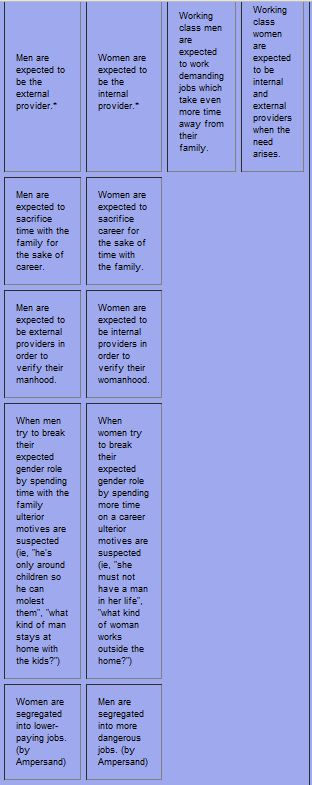
Danny’s Gender Symmetry Table

The brilliant Danny of Danny’s Corner has created this great gender symmetry table:

This is just a small part of it. You can find the entire table here.

This is the kind of feminism I’m interested in.

Nominating Simon Baron-Cohen for the Best Comic of the Year Award

In his recent article on the bugbear of autism, a trashy journalist Michael Hanlon mentions that Simon Baron-Cohen is a cousin of the comedian Sacha Baron-Cohen. I don’t know, in my opinion Simon is such a great comedian that Sacha must find it very hard to compete.

Simon Baron-Cohen’s most recent theory on the horrible and terrifying rise of autism is so hilarious that one can use it to entertain people at parties for years. As an autistic who is always on the look-out for material to discuss at social gatherings, I, for one, feel grateful to Baron-Cohen for his latest exercise in idiocy.

Baron-Cohen begins his comedy routine by introducing the concept of a “male brain.” If you think that a male brain is a brain possessed by a male, think again. Something so straightforward and logical wouldn’t be funny, and Baron-Cohen never allows reason to stop him when he is trying to fashion his latest theory. In the bizarro land this comic inhabits, a male brain is that of an autistic. Even when the autistic in question is female.

Real autistics have “extremely male brains”, whatever that means. For Simon Baron-Cohen, “male” and “extremely male” are terms that stand in lieu of everything positive. Which means that “female” and “extremely female” . . . I’m sure you can continue this simple thought on your own.

You don’t have to be an autistic genius with an extremely male brain to figure out where this comedy routine will go next. The next step down this road is, of course, blaming feminists for women getting smarter and upgrading their stupid female brains in the direction of becoming male. Or even, oh horror, extremely male.

I just imagined a woman’s brain growing a penis and realized that Baron-Cohen is a comedic genius of an incredible range.

So imagine what will happen if two owners of extremely male brains marry. Wait, is gay marriage legal now? That would be good news. Until that happens, though, maybe we should have the courage of our society’s anti-gay convictions and prevent the owners of extremely male brains to marry, what do you think?

And then, the real horror takes place. The owners of extremely male brains can end up reproducing. Baron-Cohen searches valiantly for the best term to describe the abomination such two folks end up creating. Soon, the word is found: it’s an autistic, of course! The mystery is solved. Evil feminists conspired to rob women of their well-deserved position of subservience, and the world has been punished as a result by the advent of all those horribly damaged autistics.

Hanlon finishes his article with,

It is a fascinating theory and we await the results of the new study with interest.

I couldn’t agree more. Baron-Cohen should sell this stuff to a cable network and get a weekly comedy show. Jay Leno and Conan O’Brien never came up with anything even remotely this funny so effortlessly. Baron-Cohen, however, churns out these theories like hot cakes.

Thank you, marc2020, for bringing me this great link!