As much as I was looking forward to reading José Penalva’s Corruption in the University, I have to admit that the author chose the worst possible manner to address the important issues of nepotism, corruption and harassment that exist in the system of higher education in Spain. For one, Penalva chose to write a novel (or something approximating it.) He might be a brilliant researcher in his field (which is Pedagogy), but a writer he is not. The first person present-tense narrative by a fictional young scholar José Montag alternates between short, choppy statements and long convoluted sentences where Latin expressions exist side by side with Sancho Panza-style proverbs. The author’s writing style relies on repetitions to the extent where the reader begins to wonder how much of the text was simply copy-pasted. To give an example, the narrator mentions that he “didn’t want to take off his pants” (meaning he didn’t want to be humiliated by his colleagues) so many times that I was practically ready to howl every time I encountered this phrase yet again.
Penalva makes the book even less endearing to the reader by his insistent references to Don Quijote. The novel’s narrator obviously sees himself as some kind of a Quixotic figure and even uses the famous opening sentence of Cervantes’s masterpiece as the first sentence of his story. An author whose writing is so poor from the aesthetic point of view and who lacks a realistic vision of himself to the degree where he would compare himself to Cervantes is not to be trusted in terms of the message he is trying to communicate about the system of higher ed.
Penalva’s protagonist is as lacking in social skills as he is in being capable of seeing his own actions with any degree of self-criticism. I’m not extremely good at interpersonal communication myself, but even I know enough not to tell my dissertation committee during the process of my defense that the committee members are to blame for Franco’s dictatorship since they lived under Franco and did nothing to fight him. It is also pretty clear to everybody but Penalva’s character that it might not be the best idea in the world to tell the scholar you want to be your thesis advisor that all you want from him is his signature on the dissertation form and that you have no interest in being directed by him in any way.
The book’s protagonist dislikes absolutely everybody he encounters. Colleagues, administrators, undergrads, graduate students, union members, judges, lawyers, journalists, politicians, and secretaries are all profoundly evil creatures who conspire to persecute this brilliant young academic.
The protagonist insists that he is the only one who actually does any work at the entire department of Pedagogy. He is also the only faculty member ever to visit the library, which he does while the evil colleagues meet in secret to conspire against him. Even a former professor who works for a different university and his own lawyers betray José.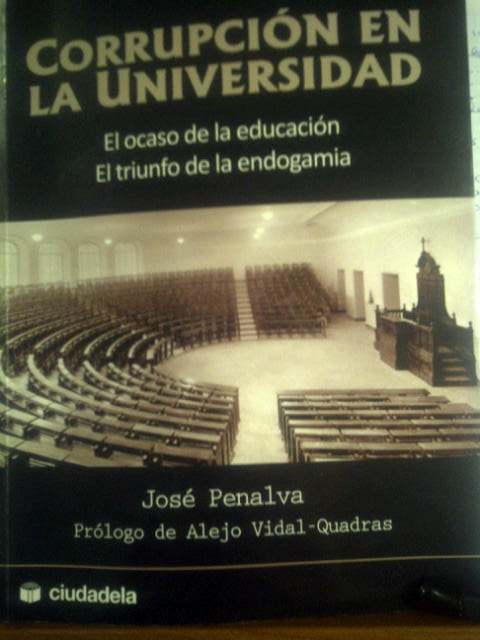
Don’t get me wrong, I have no doubt that corruption is rampant in the Spanish system of higher ed. However, I find it extremely hard to believe that every single person at a university – except for one persecuted academic – can really be an irredeemable villain. As my professor used to say, “If it seems to you that everybody else in the room is a complete idiot, there is probably just one idiot in that room. And that’s you.”
In the Prologue that Penalva writes under his own name, he indicates that the reason why he was subjected to harassment at his university in Spain is that his vision of his field is so innovative that other academics find it difficult to accept it. He fails, however, to explain what it is that his approach to Pedagogy entails. I am not completely alien to this discipline and I believe that I would have been able to understand Penalva’s insights into Pedagogy had he managed to transmit them with any degree of clarity. His failure to do so makes his claims of professional and scholarly superiority suspect.
When I first heard of this book, I was hoping that finally somebody had written a fact-based study of corruption in Spanish system of higher ed. We all know that such book is sorely needed. Unfortunately, Penalva’s Corrupción en la Universidad is so poorly structured and badly written that it sounds like a 200-page rant of a person who is so rigid, unbending and lacking in self-awareness that he manages to make enemies wherever he goes.
My heart goes out to a fellow academic who obviously endured some pretty vicious harassment at his university. (Even though I find it difficult to believe that academics who want to get you out of their department are truly likely to resort to death threats.) However, the way he chose to denounce the injustices done to him is simply counter-productive. Penalva’s alter ego José Montag keeps repeating that there will be a sequel to this book. In that sequel, we will supposedly find factual proof of the harassment he suffered. It remains unclear whose harassment the narrator means: the fictional one he experienced in the novel or the real one suffered by Penalva. I don’t think that the readers of the first book in what promises to be a series will care enough to want to find out.

 Clarissa's Blog