And Diego wins the contest announced in the previous post! The very unusual thing I saw on campus yesterday was, indeed, a taxi:
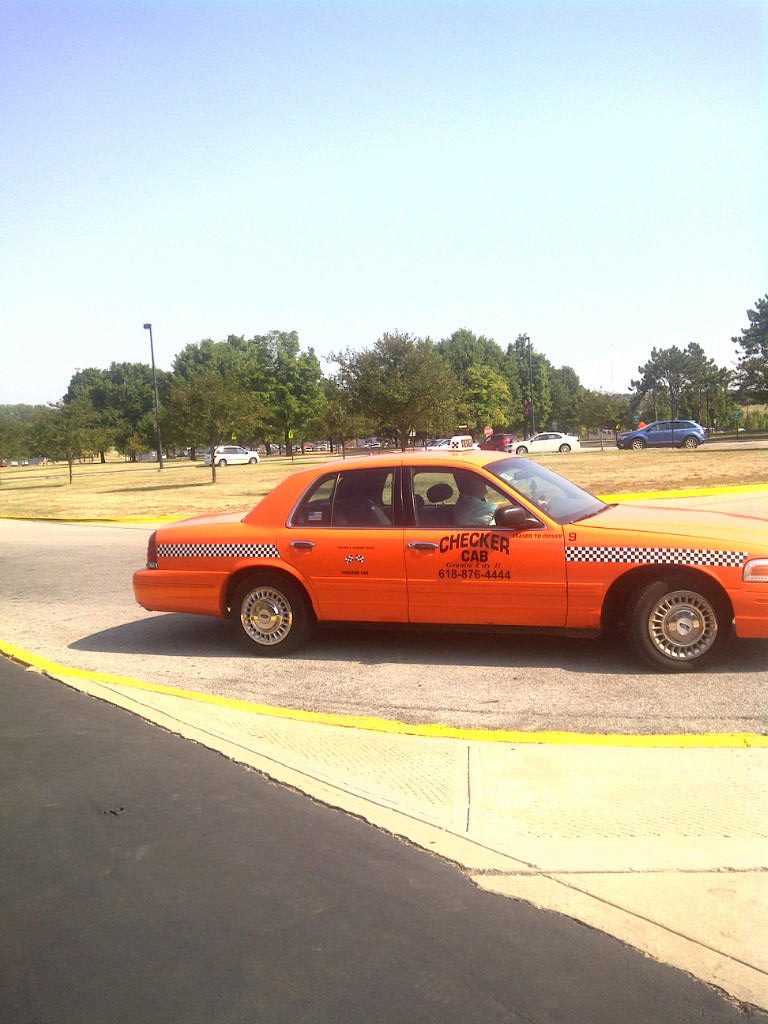
Honestly, I’d have been less surprised if I’d seen an elephant on campus. Oh, how great life is in places where cabs are a normal part of daily existence! Freedom from a car is one of the first and foremost markers of civilization. In our area, at least, we have a very good public transportation system. There are places, though, where one is practically crippled without owning a money-guzzling can at all times.

 Clarissa's Blog
Clarissa, the place you live is utterly beyond my capabilities of comprehension. You know what I assumed your student-demography to be when you spoke of their trouble with what I think are basic English words (and most of your students’ first language is English). Now you say you live in a place which doesn’t have taxis. Yet Diego says it’s a small city. I just can’t wrap my head around the living conditions here. It’s not that they’re bad, per se, but they’re so utterly *different* from the places I have lived in that this place sounds completely uninhabitable for me.
On the other hand you have buses. Big plus, that. But is this just the uni’s bus service or the city’s?
LikeLike
The university doesn’t have a bus service. It isn’t needed because we are served by the Metro St. Louis public transportation system.
Edwardsville isn’t really a city. It has a tiny little downtown area which is three blocks of buildings exactly. And the rest of the town’s population is scattered for miles and miles around. There are little enclaves for rich people (I might post some photos soon), little enclaves for extremely rich people, enclaves for middle-class folks and a few areas for the poor people. But there are vast stretched of unused land between all the enclaves. And I find this completely incomprehensible. Why wouldn’t people want to settle closer to each other and share services and store access? Why are the residential areas so far removed from shopping areas? Wouldn’t it make more sense – just in terms of profits – to make shopping easier for people? Surely, people would spend more if they could just pop into the store at any time instead of having to drive forever to buy anything?
Then, there is an area of doctors’ offices. There are dozens of doctors’ offices there and no housing for miles and miles around. Wouldn’t it be easier for a doctor to attract clients by placing the office in a residential area? What’s the point of staying in the same place with all your competitors?
This simply makes no sense even from a purely capitalist point of view.
LikeLike
But that is part of my thesis about the evolution of capitalism [maybe I should post my research sometime?] — it didn’t evolve on purely profit-centric principles. Very far from it, in fact. Ideologies of race, ethnicity, identity, religion and above all, power, shaped capitalism in every single instance. If living apart from shopping centres meant keeping the poor/minorities deprived of resources, therefore easier to control, then people with means of transport, be it the buggy or a SUV, would inconvenience themselves and make local administration build a shopping area further away.
Of course, in countries with extremely high population densities — like India — there’s no way you can stop poor people settling near resources, but spatiality is only one aspect by which you can control access. India sees these other forms all too often.
LikeLike
‘But that is part of my thesis about the evolution of capitalism [maybe I should post my research sometime?] — it didn’t evolve on purely profit-centric principles. Very far from it, in fact. Ideologies of race, ethnicity, identity, religion and above all, power, shaped capitalism in every single instance. ”
-Ah, so I’m not crazy!!! Whenever I say that capitalism nowadays is not driven exclusively by the profit principle and that there are huge ideological influences that shape it, everybody laughs. It’s good to know you think so, too. And you have an education in economics, so people are more likely to listen to your opinions about economics.
LikeLike
No you are not crazy. Capitalism, as everything else, is indeed shaped by many influences. In this case, though, low oil price is what allowed those who wanted sprawl to create it. The process of keeping that price low is, however, costing us the biosphere.
LikeLike