Via Jonathan Mayhew’s blog and the Bureau of Labor Statistics:
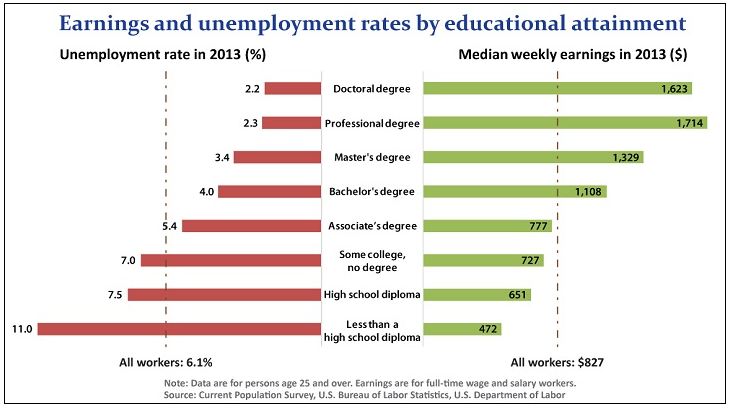
This difference is only going to intensify due to the reasons I have amply explained this year.
Opinions, art, debate
Via Jonathan Mayhew’s blog and the Bureau of Labor Statistics:
This difference is only going to intensify due to the reasons I have amply explained this year.

 Clarissa's Blog
Clarissa,
These sorts of statistics are amenable to a few different and plausible interpretations:
1) Grad school increases the value of what one offers on the job market. If they didn’t have a graduate degree they would not have as many marketable skills.
2) People who get graduate degrees are smart, organized, hard-working, good communicators, etc. If they had gone on the job market with just a Bachelor’s degree they would have out-performed the average BA/BS recipient.
3) People with graduate degrees command higher salaries primarily because of the causes listed in item 2, but the graduate degree signals to employers that they have these attributes.
Of course, in practice it’s quite likely that all 3 explanations play some role, and that some of those explanations are more important in some fields than others. In order to disentangle these factors you’d have to track two cohorts of students, who completed their Bachelor’s degrees with similar accomplishments and markers of skills and ability, but half went on for graduate degrees while the other half immediately entered the work force.
LikeLike
I should also add that these sorts of numbers look at large cohorts (ages 25 and older), and thus include people who got their start in a career when their educational credentials were rarer than now. These numbers do not directly address the value of a particular degree in the current marketplace.
However, I will grant you that these numbers are better than some that I’ve seen, in that they at least show 2013 data. I’ve seen people argue for grad school on the basis of late 90’s salary data. I think we could argue for anything on the basis of late 90’s salary data. Good times, man. Good times.
LikeLike
Yes, the 90s will be for my generation what the 70s were for the preceding one: the mythical time when sugar was sweeter. 🙂
LikeLike
I meant for Americans of my generation, of course. For my compatriots, the 90s are the stuff of nightmares.
LikeLike
This isn’t the full story. People who have moved to lower paying jobs are counted as employed, without regard to the fact that they now make a fraction of what they used to make. At the bottom end, workers may have two or even three jobs to make ends meet.
LikeLike
Did you see that this chart has both percentage of employment and average weekly wages?
LikeLike
I wonder if my PhD is worth anything. I have a very strong sense I would like to get into some ghost writing of memoirs or historical novels.
LikeLike
Clarissa: Actually what one takes from this chart (as well as your students) is become some sort of doctor or lawyer, and if one doesn’t want to do that to get a master’s. If you can’t get a master’s you should at least have a bachelor’s. And if you can’t get a bachelor’s have an associates, but don’t go to college and not finish. (I don’t count associate’s degrees because they still end up making less than the median.) Hence your students’ endless dreams of being lawyers: it’s the best paying, least time intensive degree beyond a bachelor’s and they don’t have to be elite STEM students from their freshman year of high school. [If you’re thinking of taking the MCAT in your senior year of college and you don’t have the science background, it is generally too late.]
The largest higher education employment rate advantage accrues to bachelor’s degree recipients over people with a high school diploma (in higher education).
LikeLike
I predict that in 10 years at the very latest, this difference will shift to BA versus Masters. But that’s at the very very latest.
LikeLike