This is part of (a very convoluted and weird) handout we just received:
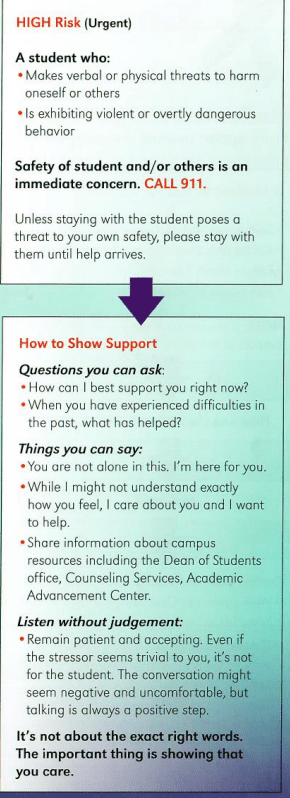
Words cannot describe how wrong this sounds. Nobody should stick their dirty fingers into the ailing psyches of distressed individuals. All of this psychobabble is downright dangerous when produced by unqualified individuals with zero medical training. This is also very hypocritical because we keep saying that mental illness is real illness, yet nobody in their right mind would advise professors to do this kind of thing for a student who is having a heart attack, experiencing a stroke or is in the midst of a hypoglycemic episode.

 Clarissa's Blog
Well if the student is having a medical emergency (heart attack, seizure etc.), we are expected to stay with the student until professional help arrives. (As long as it doesn’t put ourselves or other students at risk). This seems like just a version of that? I was assuming the bottom graphic (“How to show support”) were things you are supposed to say to de-escalate the situation as you are waiting for professionals to arrive? But I might be mis-reading the graphic.
LikeLike
“This seems like just a version of that? I was assuming the bottom graphic (“How to show support”) were things you are supposed to say to de-escalate the situation as you are waiting for professionals to arrive?”
This is a way of shifting liability from the institutions and onto individuals. And we all know how much I love that.
LikeLike
I didn’t like the ‘questions you can ask’. Are we expecting this student who was issuing violent threats a minute ago to share his innermost thoughts in front of other students? Undergo therapy in public?
Getting the fuck outta there and calling campus security seems like the best option to me. Let’s address the implied violence first.
LikeLike
But you should do something as you wait for help to arrive? Sitting in stony silence doesn’t sound like the best approach either? I am firmly against this taking the place of professional help. But as you wait for help to arrive, surely you should do something?
LikeLike
Of course, in such a situation, people will handle things to the best of their ability. The problem is that the university is trying to codify this response. This can only be done with one goal: to penalize people and shift responsibility onto them. Oh, so you didn’t follow all the 14 steps outlined in the brochure that we gave you 5 years ago? Then you must be to blame.
LikeLike
Stay there while the student is ‘making verbal and physical threats’ or ‘exhibiting dangerous behavior’? The handout seems more appropriate for someone who seems depressed lately, hasn’t been turning in any work, etc. You take them aside and point them to various campus resources that can be useful to them.
This is a violent situation. Call campus police.
LikeLike
Imagine a student going “I’m going to kill you! I’m going to start shooting right now!” and you responding “I can’t even imagine how you feel. You must be so sad!” I’m sure that will be very helpful.
LikeLike
Or worse.
Student: “I’m going to kill you! I’m going to start shooting right now!”
You: ‘How can I best support you right now?’
😀
LikeLike
“I’m going to kill you! I’m going to start shooting right now!”
“Have you considered visiting the Dean of Students’ office?”
LikeLike
That’s a good one. 🙂
LikeLike
Yeah, that’s a good one. 🙂
LikeLike
God, I can’t believe someone thought it was a good idea to distribute this dangerous handout.
LikeLike
One pretty much knows instinctively whether or not the other person gives an honest shit about them.
Going through mere charades of “empathy” and “compassion” only come off as patronizing and condescending
…a “what-not-to-do” to someone potentially dangerous or ready to fall-apart-at-the-seams.
LikeLike
Amateur Hostage Negotiation For Dummies?
Come on now, this is more than the actual police do in many instances. Why the hell do you need to talk anyone down when there is a non-trivial chance the police will just start shooting/attacking on sight if someone has a seizure or is having a break from reality or is having a low blood sugar attack (they look drunk and belligerent), etc.
Don’t be a hero, leave the area!
Supreme Court shields a police officer from being sued for shooting a woman in her front yard
Justices Rule Police Do Not Have a Constitutional Duty to Protect Someone
LikeLiked by 1 person
Exactly.
LikeLike
They have just told us we have to put in our syllabus instructions for shooting situations. We are supposed to:
1. call police
2. hide, if necessary
3. fight, if necessary
OBVIOUSLY that means they are telling us we are on our own, to fight the person. So we had better carry weapons, I guess.
LikeLike
In the past several years, possible active shooter/bomb situations have involved
–two workplaces of two exes (2013), (2016)
–my father’s workplace (2013)
— the local mall (2017)
–near my cousins’s workplace (2016)
I’m tired of this idea we’ve all got to freelance in violence and hostage negotiations. Don’t carry weapons though unless you want to run the real risk that the police will just shoot you too. Especially if you already look like a suspect to them.
LikeLike
That’s exactly the problem I’m having with this. The implicit idea here is that if this happens, then it’s your problem and your fault if you don’t manage the situation effectively.
LikeLiked by 1 person
Yes, we had a similar (mandatory) training at my work. It wasn’t all terrible, but a couple things that stood out to me were one part where the instructor discussed the possibility of being backed into a corner during an active shooting event, and that you may as well try to fight the shooter because you would probably have a better chance of surviving if you managed to startle them (fair enough) and then he shook his head and said that it was so sad that some people would just “let” themselves be shot instead of taking a stand! Like there’s any evidence that every person who tries to fight an active shooter while unarmed survives, and anyone who doesn’t survive was just making a conscious choice to “let” themselves be murdered.
The second part was when he discussed the necessity of having a well-planned and practiced escape route, that every is aware of, and a designated meeting point after you have all fled your offices, not 10 minutes after he explained that most active shooter situations are former or current employees. I asked my manager if she thought that made any sense and she agreed that it didn’t, but it’s policy to have an escape route and meeting point planned and practiced annually.
LikeLike
Jesus Lord. This is crazy.
LikeLike
Are you boggling at the idea this video has existed for several years (2012) already? Or are you boggling at the idea I can play six degrees of separation for the kinds of situations that make this type of video necessary?
LikeLike
I’ll be damned if my last words will be a futile attempt to empathize with a maniac.
LikeLiked by 2 people
I just ignore crap like this. In all of our classrooms, we have little posters about what to do in an active shooter situation. Included on these posters is a definition of an active shooter, in case we don’t know.
LikeLiked by 1 person
“In all of our classrooms, we have little posters about what to do in an active shooter situation”
In other words…. your institution is actively recruiting shooters…
“Included on these posters is a definition of an active shooter”
And instructing them on what to do.
Are you sure your institution doesn’t have a kickback deal with some cable news network?
LikeLike
And even a poster is not the same as the administration sending the flyer to employees. When you get it from the administration, it’s not a suggestion but more of an order. You do this, or else.
LikeLike