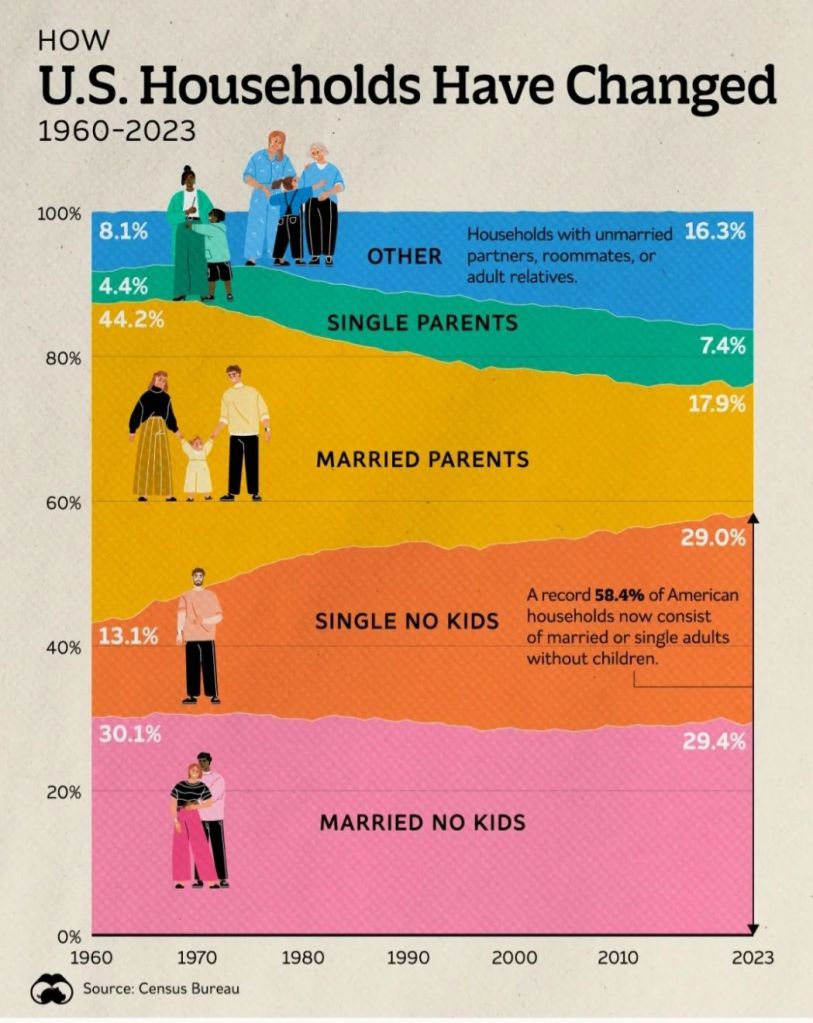
All of these changes are for the worse. Not a single positive trend is in evidence.
All of these changes are for the worse. Not a single positive trend is in evidence.

Well the snapshot on it’s own doesn’t look great. But overall trends have a lot of positives. Among college educated adults, for instance, the divorce rate is the lowest it’s been in decades.
Like you, I work in academia. Do you know anyone who is divorced? I don’t. (I know a very few who are on a second marriage. But even those second marriages are long term and stable). And the amount of single people I know past the age of 35 or so is almost non-existent. Similarly, most couples I know have children. College educated people are having children later in life and so having fewer children. But those kids are all being brought up in stable, loving households. So I see a lot of positive trends overall.
LikeLike

We are trading anecdotal evidence here but most people I work with daily are either divorced or lifelong single. Not all but the majority.
This isn’t about well paid professional people, though. It’s the working classes that have been most badly hit by divorce and family dysfunction.

We were really excited when the hispanic family moved in a couple doors down. Now my kids aren’t the *only* ones on our street with stable, married parents.
LikeLike

The chart only counts kids as kids under the age of 18 or 25 (don’t count for child credits or can’t be on their parents’ insurance) right?
The increase in single no kids means people are mostly not having kids by themselves, divorced, or widowed. That’s a victory for conservative values that shouldn’t be ignored.
LikeLike
You’ll note the chart does not differentiate between Married parents with kids, and married parents with kids from other relationships (i.e. parent is married to someone other than bio-co-parent), so… the numbers for stable families there are even worse than what’s showing on the chart.
…but hey, it looks like Global Capital is getting the infinitely-mobile detached, disenfranchised, disaffected workforce it always wanted.
LikeLike
A conservative literary critic and college professor

 Clarissa's Blog
Leave a comment