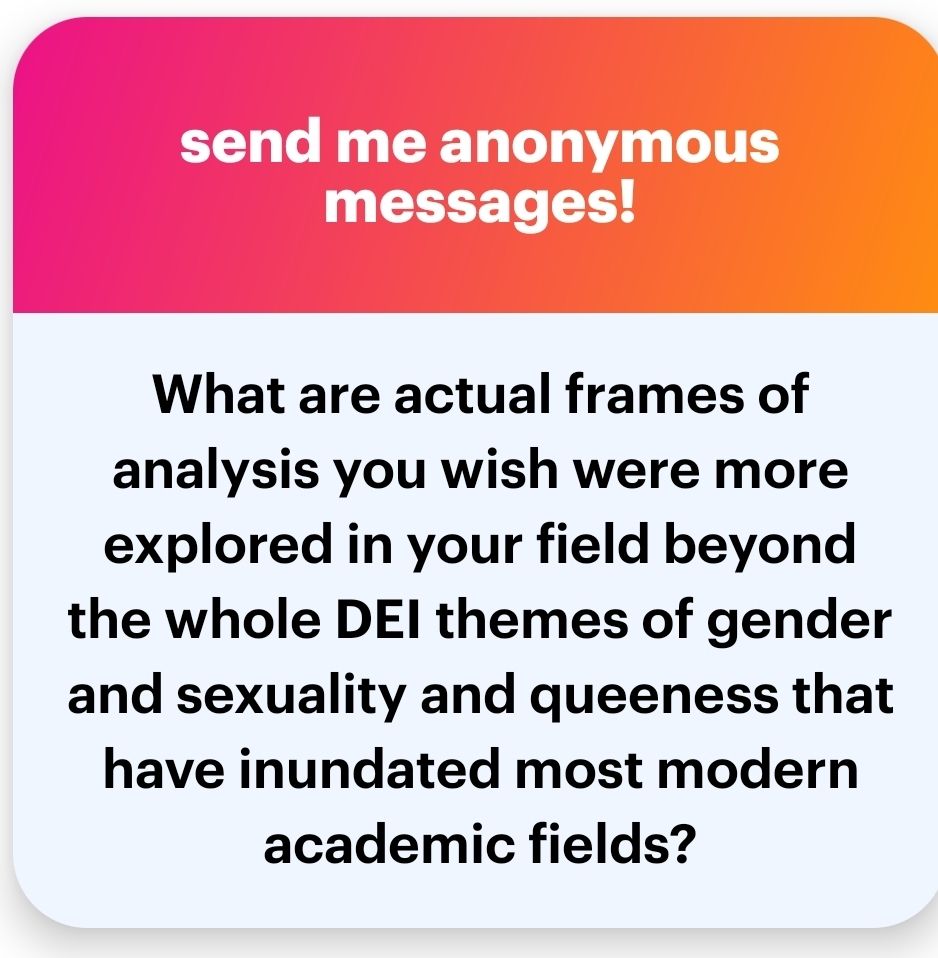
What a great question. It’s one of the best ones I’ve ever received. As all good questions it is not necessarily very easy to answer. Let me try to think it out right here to see if together we can arrive at an answer.
I can roughly subdivide university scholarship in the humanities of the mass-education time period into two eras. These areas would be pre-neoliberal and neoliberal. If you’re tired of this terminology, which I can absolutely understand, let’s refer to them as the pre-1968 and post-1968 eras. By 1968 I refer, of course, to the leftist revolution that swept the world and cleared the path for the grand economic reformatting that began 10 years later and is still ongoing.
In the pre-neoliberal era, university scholarship in the humanities—and again, I repeat, that I am speaking specifically of the era of increasingly mass education that did not begin until the very late 19th century—had two main directions of interest. One was supporting the existence of the nation-state by way of establishing the national literary canon, defining the national history, exploring the specific political structures of the nation-state, etc. The second direction was, to put it in simple terms, figuring out how things work. What makes works of literature enjoyable? Which political system is the most rational? Which events of history had the biggest impact and why? These are very important issues to ponder but their big defect is that their reach is limited. They do not provide an infinite number of people with an infinite amount of work.
At the beginning of the massification era, these two directions managed to provide enough to say, to write, and to publish for the few people in higher education who did research. But then more people wanted to join the field of intellectual endeavor. They needed something to write about. They needed what we today would call a hack that would break open for them an infinite cache of possible subjects of exploration. They found it in the way of thinking that prizes the destruction of every familiar category above everything else. This way of thinking has many names because today it is so dominant and omnipresent that is very hard for us to give it a specific name. It has become part of every single one of us. I call it in neoliberalism. Other people call it cultural Marxism. But there are many other names.
I know how much everybody hates long posts, so I will continue this one later. Thank you, the wonderful person who left the question, because I am really loving it.


Leave a comment