Even in Squid Game 2, there’s a trans character who is, of course, absolutely saintly. One can’t hide from this crap anywhere.
All true. We would be coasting to victory right now, happy and unbothered, without the moronic Iran war. In the…
Even in Squid Game 2, there’s a trans character who is, of course, absolutely saintly. One can’t hide from this crap anywhere.
In 1979, Rhodesia elected its first black Prime Minister, Bishop Muzorewa. The Carter administration branded him a “neo fascist” because he was politically centrist. Instead, Carter wanted the bloodthirsty Mugabe to be installed. Unlike most other things, Carter was successful at this goal, and Mugabe took control of the country.
What I find instructive in this story is that leftists don’t learn new tricks. Decades go by, and their only argument is that everybody who disagrees with them is a racist and a fascist. That they managed to get such cultural ascendance on nothing but name-calling and claims of deep sensitivity is shocking.
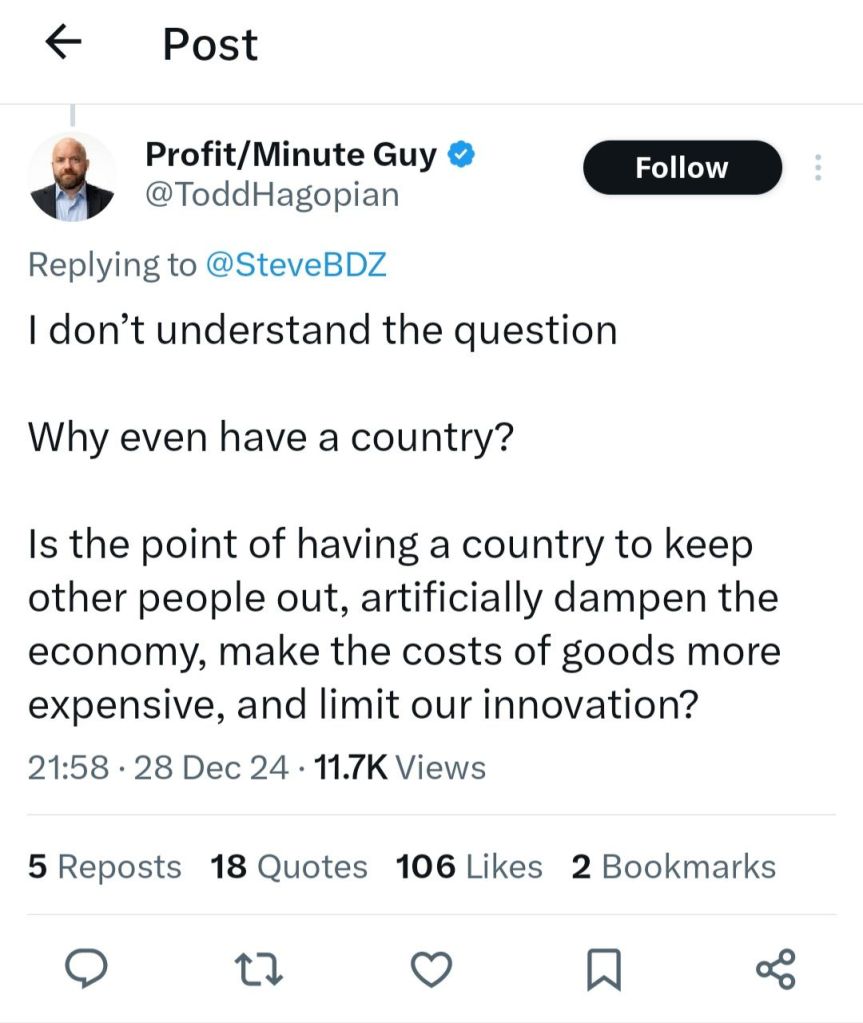
See? I told you. They want to play the squid game, poor bastards. And the saddest thing is that this dude is like the flabby 60-year-old in season 2. With these intellectual limitations, poor verbal skills, and looking 20 years older than his actual age, he’s not all that competitive. But he’s very sure he is precisely because the country he scoffs at provided him with opportunities. And in return, he wants to throw it onto a garbage heap.
Is anybody on here watching Squid Game 2? I really identify with the main character who’s standing in front of a crowd, yelling “People, don’t play with neoliberalism. I’ll win but you won’t. Stop and go home!’ And people roar, “No, we want to play! This is winnable!”
Comments:
Ian Smith’s memoir of the handover of Rhodesia to Soviet-backed Mugabe is a depressing account. It also strikes a little too close to home to read about a naively pro-Western country being handed over by Kissinger and Co to Russians and their North Korean toadies. Maybe I should have waited to read the book to avoid being haunted by the similarities.
After reading Bitter Harvest, I’m not sure to what extent there actually was a Cold War. The British and the Americans seemed hell-bent on handing large swatches of the world into Soviet control. But at least I now have an answer to a question that puzzled me for years. The USSR I grew up in was mismanaged, bumbling and inept. Having physically eliminated most people with well-functioning brains and terrorized the rest into submission, it was led by geriatric morons who couldn’t tell their ass from their elbow even in their better years. How, then, could a country of glorified mediocrity end up controlling half of the world?
Well, now I know. Everything was done by the supposed opponents of the Soviets to strengthen the Soviet cause.
Ian Smith’s book is very long and extremely detailed. Often, it’s a little too detailed, making it hard to follow all the intricacies of the Rhodesian political scene. It’s a commonplace that history is written by the winners. Yet, even though Smith lost every single battle, from huge to minuscule, in his efforts to keep his country livable, his opponents have no defensible position. There’s no narrative of why Mugabe was a better leader than Smith and why the entire free world needed to work so hard to install Mugabe as Zimbabwe’s dictator.
I regularly try to read something about Africa. This, of course, lies on the very periphery of my interests, and time is scarce. Still, I believe one could do worse than acquire at least some basic knowledge about the continent. What I find paradoxical, however, is that our reigning system of morality finds me, a person who only wants to read about Africa out of sporadic curiosity and have nothing else to do with it, to be superior to Smith who loved it, understood it, belonged to it and wanted to make it better. We have accepted that the apartheid of “us here and Africans way over there” is superior to Smith’s belief that apartheid was wrong. He’s the bugbear, the evil racist, and we are good and virtuous.
Talking about poetry, which of the two translations of a snippet from The Odyssey do you prefer?
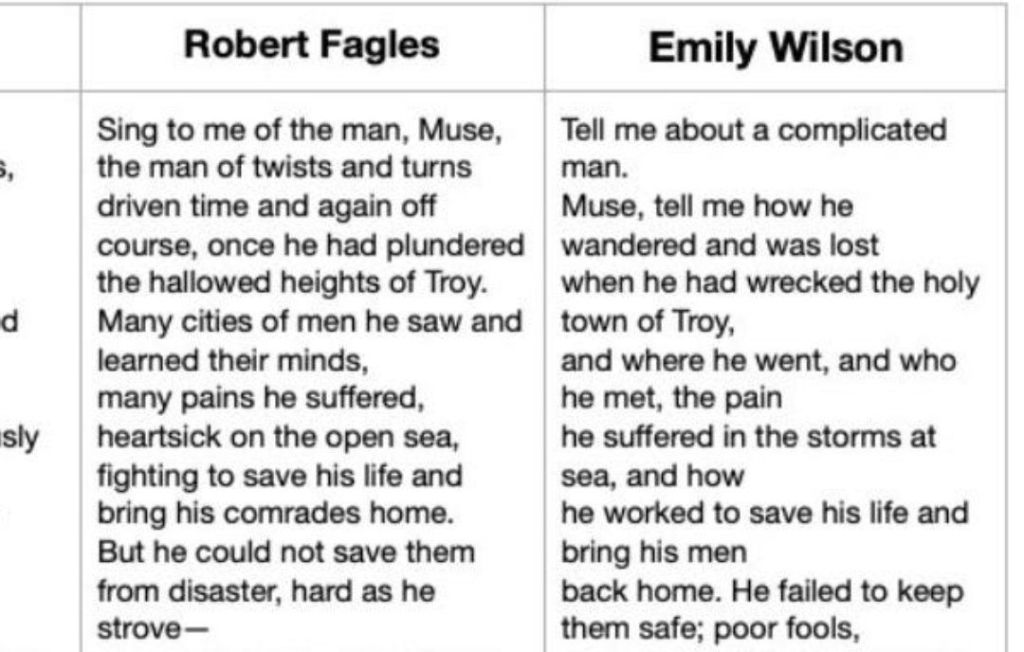
I’m in the Wilson camp because “a complicated man” is bolder, clearer and more exciting than the clunky “man of twists and turns.” I like that Wilson isn’t trying to fake an ancient Greek mood and makes it clear she’s doing a modern translation.
As a translator, I like making the text my own, going as far out there as possible. Translation is not for the meek or those lacking in perspective.
Today Klara treated me to an animated half-hour disquisition on baseball, replete with terms like outfielder and second base, and I’ll never get over having a completely American child.
I understood not a word of the talk but I did experience paroxysms of cuteness attacks.
On today’s show I finally looked like myself, and viewers mentioned that I look like an actress from the movie American Pie. I don’t know the movie or Hollywood actresses. Can anybody link or post a picture of whoever in that movie looks like me? I’m trying to figure out if this was a compliment or a criticism.
And by the way, what a stupid fad to call actresses actors. So dumb.
Watch me in 10 minutes live when I talk about AI, and I promise it’s the last video this year.
I don’t know how widely it’s reported in the US but 38 people died, and it’s a tragedy:
Azerbaijan Airlines plane shot down by Russian missile
The crash of the Azerbaijan Airlines plane was caused by a Russian surface-to-air missile, Euronews reports, citing sources within the Azerbaijani government.

The Russians shot the civilian airplane and then refused to let it land. Heroic pilots still kept it up in the air for 500 km, begging be allowed to land but nobody cared.
In short, if you need to visit the Eastern Hemisphere, don’t fly over Russia.
A conservative literary critic and college professor


All true. We would be coasting to victory right now, happy and unbothered, without the moronic Iran war. In the…

The Trump administration is scatterbrained because Trump is scatterbrained. Period. This is the iron rule of organizations that I’ve been…

Yeah, the problem with the AA nonsense is the reality that small employers cannot afford to discriminate because ignoring superior…
Teachers have to pass somebody. They can’t fail the entire class. The result is that there are schools where, in…

GPA is meaningless. Show me their SAT scores.
If we were talking SAT scores it might mean something. GPA is not something that can be meaningfully compared across…
Exactly. We work with students from East St Louis at my university. We do great work with them. It’s a…
LOL, Kid, DEI is simply the latest term for the insane policy of awarding a position to an applicant based…

“The talented student in a crime ridden neighborhood is a fantasy” And if such did exist you’re not going to…
“grades at a crappy school are worth less than grades at a good school.” Exactly… he might get a 3.8…
One of the great things about not really being compatible with video formats is… I could not possibly care less…

Exactly right.
The talented student in a crime ridden neighborhood is a fantasy. Also, grades at a crappy school are worth less…

The problem with the quoted example is that the difference between 3.9 and 3.8 GPA is essentially meaningless. What kind…

You would want student 2 as your doctor or pilot, but w/o DEI would get the mediocrity of student 1…
The idea is that student 2 is much smarter than student 1, but because of his hard situation his grades…
In my town here in Illinois, we used to have a local butcher shop. You could see people bringing in…
People have been bringing up the new short-lived WH press secretary. And yes, she’s embarrassing, stupid, ridiculous. Looks like a…
Have to admit my sample of latinas is small, but they were all pleasant and very feminine.
Hmmm, wonder if that might be a relic of Al-Andulus? Not being personally envious, just pointed out that we have…
IKR? And yet, in Lima, we could buy better-quality meat and produce everywhere: the big mercado, the corner tienda, and…
-Do you consider the WSJ an unbiased source on this subject? -Cocaine really isn’t my top concern. The admin, whatever…
It’s exactly what I find so annoying. Whenever I bring this up, people tell me that there is a way…

Yet another brain dead policy that is also not working at all. Cocaine has never been as plentiful, cheap, and…
I love the Hispanic culture, as we have all, I’m sure, realized. However, in the culture of this type, where…
meh. I had no interest in watching it, but I’m still not sure it was a bad idea. Broadcasting video…
“was there a turning point?” I wish I knew. I grew up with junkfood vegetarians, and it took me years…
“This is a culture that never had a Jane Eyre.” True, nor did they suffer the ugly lies of “The…
Kid, afraid that may be the real cost of producing high quality food. Local women were pretty industrious about harvesting…
“Nearly everywhere else in the world, poor people can afford better quality food than I can buy in the US”…
This is what gets me. Nearly everywhere else in the world, poor people can afford better quality food than I…
the worst part is that huge chemical load kills the soil. We don’t even have studies yet for some of…

Great response Clarissa. I’m a dilettante in world literature, but I understand what you are talking about.
Our local farmers market has become too expensive even for me. This summer, I went twice, but the prices are…
Do you have any farm markets or Amish outlets anywhere near you?
I didn’t say it was minor. I said it was minor compared to what the Democrats offer. We don’t have…
“I have no idea why the word female is in the title” Well most native speakers see “the female of…
If only this wasn’t seriously hurting people right now, I would agree it is “extremely minor.”Look at what’s happening in…
I lost 5 lbs in 3 weeks out of the country. It happens every single time. I come back and…
I lost 5 lbs in 3 weeks out of the country. It happens every single time. I come back and…

