Example of the Postmaterial Realm

This administration can’t give people anything except for a sense of fake moral superiority. So that’s what it gives in spades. This is the definition of the postmaterial realm of politics.

And yes, Trump did that too with his endless “build the wall” while not building any wall.

History of Neoliberalism in Spain

I’m reading about the history of neoliberalism in Spain, and it’s very instructive.

In 1982, the Spanish Socialist Worker Party achieved a historic landslide win in the general election. Immediately (and I mean, really at once), the Socialists started putting in place a gigantic austerity program that, according to contemporary sources, was Thatcherite in inspiration. By the end of their first year in power, The Washington Post published an article observing how anti-labor and pro-business these Spanish socialists were.

At the beginning of the 21st century, it became obvious that a massive recession was inevitable. But the Socialists, who were hoping to come back to power in 2004, were still completely neoliberal, pro-austerity, etc. How to get people to vote for them when everything they had done in the 1980s was backfiring?

The Socialists did the exact same thing that today is done by every global corporation. They rebranded towards “social justice.” As one scholar says, they went heavily into the postmaterial realm to mask what they were doing in the material realm. Abortion rights, gay marriage, and the endless drumbeating about the Civil War of 1936-9 were aimed at distracting people from the real estate bubble that was about to pop and the plummeting working conditions. “We are antifascists and our opponents are fascists” became their favorite argument. It worked because it always does.

Today, when Spain is still processing the devastation of 2008-9 while dealing with the added devastation of COVID, the Spanish Socialists who rule in coalition with the far-left are even more aggressively touting their postmaterial social justice achievements. For example, just as they announced terrible price hikes on energy that will financially ruin several hundred thousand citizens, they conducted a series of “toy strikes.” Toys go on strike to protest against gender stereotypes in how children play. In a situation where a tragic number of young people report not being able to afford having children, these bastards have the gall to offer vapid, stale talking points about gender stereotypes in toy marketing. Imagine how this must feel to people who are in their mid-thirties, still dreaming of maybe having a kid one day while hunting for a gig that might employ them 10 hours a week. Like all leftist performances, this one is deeply cruel.

As I said last month at a conference, it’s funny how “reproductive rights” are always and only about the right not to have children. They are never about the right to have as many children as you want, even today when the number of women in Spain who report being prevented from aborting is minuscule in comparison with the number of women who report not being able to afford having the children they want to have. This produced a bit of a stupor in the audience until two female academics in their early thirties loudly and almost tearfully supported me. (In general, I’m finding that it’s a lot easier to explain my ideas to academics under 40 and / or from Spain.)

The lesson here is that masking economic dispossession with social-justicey claptrap was first invented by leftist political parties and then eventually imitated by global companies.

What we need to remember is that whenever a politician or a corporate boss starts going on about anti-racism, social justice, and anti-fascism, they are out to rob us. This is a con, a trick to use our better impulses against us. We need to learn to resist these emotional appeals and see them for a dirty trick that they are.
Zero Takers

Our university pairs established academics with early-career colleagues who need mentorship. I offered my services in how to become a successful research scholar in the Humanities while working at our university, with its high teaching load, low resources, non-existent institutional reputation, and no library to speak of. From my CV it’s obvious that I cracked the code and know how to do it. Our research requirements for tenure are so low as to border on none. I can’t advise people on how to do just enough research to get tenure. I honestly have no idea. It’s like being a little bit pregnant. Impossible. I don’t know how to publish one article in 3 years. But I do know how to publish at least 3 every year. It’s actually a lot easier, believe it or not.

Do you know how many people were interested in my proposal?

Zero.

Not even out of curiosity did anybody agree to participate. This is the only reason why I don’t like my university. It’s a place for people who are anti-research. And an academic who doesn’t have an active and busy research agenda either needs to develop an overwhelmingly absorbing hobby or become bitter, neurotic, and perennially angry.

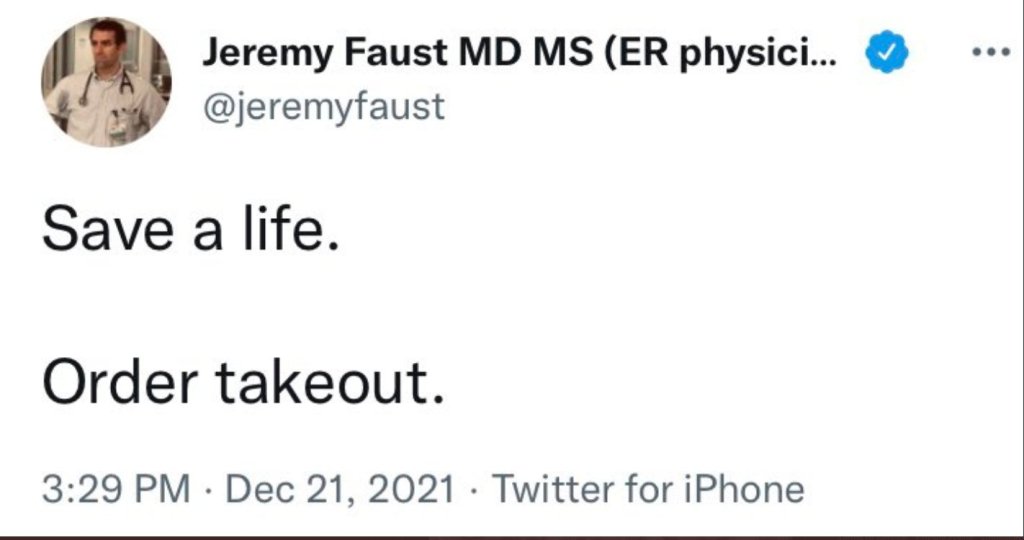
Order Takeout

Mr MD MS ER physician either believes that takeout food is spontaneously generated in nature and flies to his house on wings or that cooks and delivery people are not human.

One of the biggest revelations of the COVID era is how many people in the medical profession are mentally ill idiots. I recently read a Twitter thread of pediatricians, and it was a sad, disheartening experience.

Don’t Judge the Gamble

I don’t get the people who keep saying that Kyle Rittenhouse should avoid publicity and “go back to normal.” Have they read about his family? Do they fully understand what his “normal” is like? Would you want to go back to that kind of normalcy if you had a chance to escape it?

He now has a nationally recognizable name. He has a chance of enormous class mobility that otherwise he’d never get. He can meet famous people, make money, develop a brand. Maybe he’ll fail but you’ve got to be a Tibetan monk to reject such an opportunity.

When you get a chance to reject wealth, comfort and fame for a life of anonymous striving, then judge this kid. Otherwise, honestly, I find it very hard to believe that you wouldn’t take this gamble.

Left of Communism

Behold the new president of Chile:

Lord have mercy on Chile.

Democracy and Life

Thinking about democracy, democracy is great because it follows so many of the principles of a happy human life. It’s also not great for the same reason.

In democracy, as in life, you win some and you lose some. A happy person is the one who accepts the inevitability of losses and doesn’t see them as a terrible injustice that has to be battled permanently. A democracy functions when everybody accepts that their side will lose and that’s fine. Unpleasant, painful but fine.

In democracy as in life, it’s all about tradeoffs, and progress happens very very slowly with a lot of setbacks. Anybody who has tried to lose weight or learn a new skill knows that. There are no instant fixes and happy pills. Everything is excruciatingly slow. Egos need to get smaller and humility bigger.

Once you lose the capacity to accept this, democracy goes to shit and so does your life.

Book Notes: Stanley G. Payne’s In Defense of Spain

This is a wonderful book by a great American historian who specializes in Spain and European fascism. In Defense of Spain offers an overview of the entire history of Spain and refutes some of the commonly held myths about this country. Unexpectedly, I discovered that I knew everything that Payne has to say about the Middle Ages, the Enlightenment, and the 19th century but (and this is the surprising part) I found a lot of stuff that was new to me in the part that discusses the Spanish Civil War. This is what I teach! I’m supposed to know it. But it turns out that I was taught a lot of garbage about the Civil War that I then diligently repeated. Here are some points that might seem arcane to many of you but they matter to me:

1. The election of 1936 was falsified in a pretty blatant way. This means that the whole narrative about the civil war being an insurrection of a fascist military against a “legitimate democratic government” that we are all taught to recite like parrots is bunkum. The Spanish left turned out to be incapable of accepting any democracy that didn’t give them a permanent majority. Which is not really a democracy. It really reminds me of something. Hmm, what can it possibly be?

2. Franco did not want to participate in the uprising until a prominent right-wing politician was assassinated by the Socialists. This is not to justify Franco in any way – nobody likes Franco or dictatorships – but the import of that political assassination is often minimized.

3. During WWII, Luis Carrero Blanco (the guy Franco wanted to be his successor until Carrero Blanco was assassinated by the Basque terrorists in 1973) tried hard to persuade Franco to stop stanning for Hitler like a besotted groupie that he was. “There is absolutely no moral and religious difference between Nazism and Stalinism,” Carrero Blanco implored. I didn’t know there were people so close to Franco who understood this.

4. In 1943 Franco finally officially stopped supporting Hitler because the US pressured him to do so by withdrawing petroleum supplies. This meant an immediate death to the entire Spanish economy, so Franco had to agree.

5. After 1943, Franco tried to convince Churchill to form an alliance between the UK and Spain that would oppose both Hitler and Stalin but Churchill couldn’t betray his buddy Joe.

6. This, of course, I knew but it bears repeating: Franco was not a fascist. This doesn’t mean he was a good guy. He was a brutal dictator, he had a million flaws. But his alliance with the actual Spanish fascists was unwilling and short-lived. After the war, he eviscerated those little bastards. Which, for the millionth time, does not make Franco a good guy. It’s an unfortunate reality that whenever you say that Franco was not a fascist or that the economic transformation of Spain during the dictatorship was an absolute miracle, people immediately assume that you hate democracy and support dictatorships.

7. And by the way, Franco believed in social justice and used this exact expression. Which might be among the reasons why I hate it so much.

I read the book in Spanish but I think that in English there is a close enough version titled Spain: A Unique History. I also discovered that Payne wrote a book on the Soviet involvement in the Spanish Civil War and I have requested it from the library.