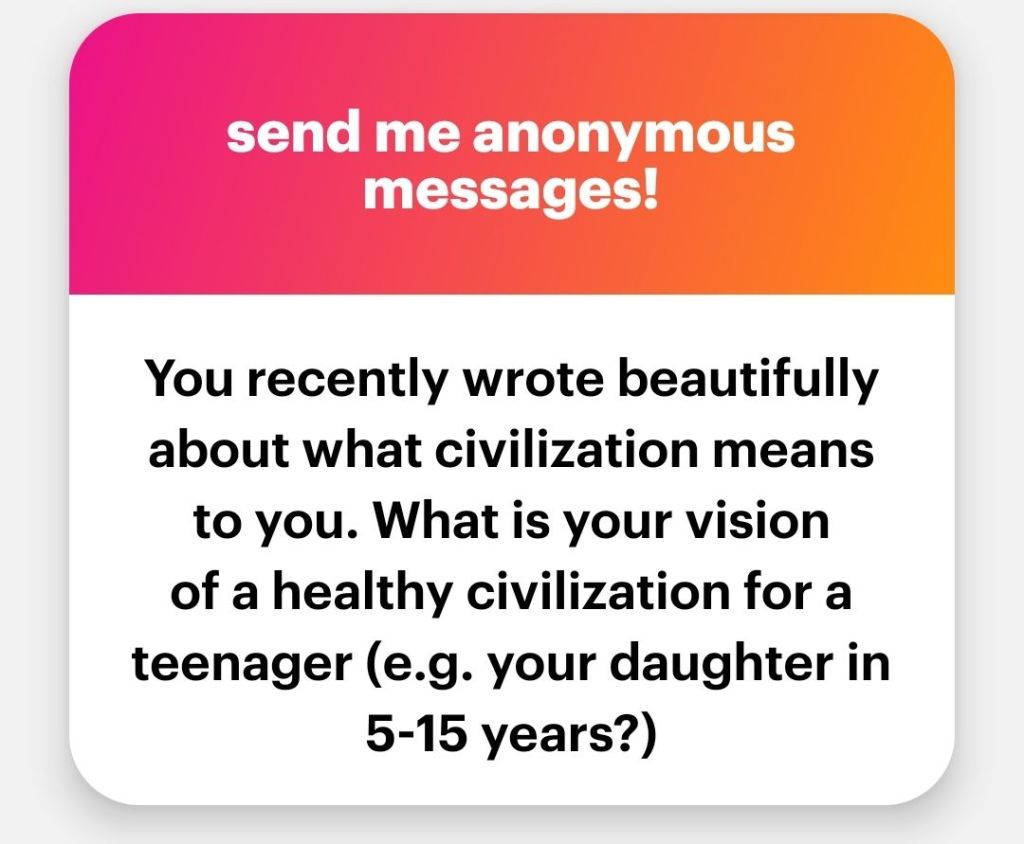
Q&A About Teenagers

I don’t have an imagination, unfortunately. Imagine the novels I could write if I did. But I never was a teenage girl in America and never spent time with any. What I wanted most dearly when I was a teenage girl – menstrual products and no sexual harassment in the streets – already exists in America. My imagination doesn’t stretch beyond that.

Friends, can you help us out? What makes life good in a healthy, positive way for an American teenager?

Thank you for “wrote beautifully”, by the way. I’m surprised anything is left in me after the work I’m putting into Neoliberal Love.

6 thoughts on “Q&A About Teenagers

  1. Good friends with good values. School, or at least public school, is, with a few notable exceptional teachers, in the words of our son: “A waste of my oxygen”. But it does provide a platform to meet like minded teens, and participate in theater, sports, music/art and other shared interests. Having siblings/friends who share your passions, understand you because they’re your peers and not parents or teachers, and have “been brought up right” are the key, I believe to making the best of these crucial years.

    Liked by 1 person

  2. You yourself have spoken of the sexual horror show young women are entering into in modern America. That seems like an obvious change to make. I know a young, sensible woman with a good head on her shoulders who wondered if it was stupid to want to save sex for someone she loved. Things were not so bad even 15 years ago.

    More generally, American culture seems to have lost what used to be common sense knowledge. We don’t know the solutions to our problems because the cultural values that offered a solution were discarded a few generations ago. Young people can’t even turn to their parents for help because they don’t know either. People grope blindly in the dark and learn haltingly through painful experience, or more commonly they don’t learn at all.

    Liked by 1 person

    1. From Slouching Towards Bethlehem:

      “We were seeing the desperate attempt of a handful of pathetically unequipped children to create a community in a social vacuum. Once we had seen these children, we could no longer overlook the vacuum, no longer pretend that the society’s atomization could be reversed. This was not a traditional generational rebellion. At some point between 1945 and 1967 we had somehow neglected to tell these children the rules of the game we happened to be playing. Maybe there were just too few people around to do the telling. These were children who grew up cut loose from the web of cousins and great-aunts and family doctors and lifelong neighbors who had traditionally suggested and enforced the society’s values. They are children who have moved around a lot, San Jose, Chula Vista, here. They are less in rebellion against the society than ignorant of it, able only to feed back certain of its most publicized self-doubts, Vietnam, Saran-Wrap, diet pills, the Bomb.

      They feed back exactly what is given them. Because they do not believe in words—words are for ‘typeheads,’ Chester Anderson tells them, and a thought which needs words is just one more of those ego trips—their only proficient vocabulary is in the society’s platitudes. As it happens I am still committed to the idea that the ability to think for one’s self depends upon one’s mastery of the language, and I am not optimistic about children who will settle for saying, to indicate that their mother and father do not live together, that they come from ‘a broken home.’ They are sixteen, fifteen, fourteen years old, younger all the time, an army of children waiting to be given the words.”

      Like

  3. You yourself have spoken of the sexual horror show young women are entering into in modern America. That seems like an obvious change to make. I know a young, sensible woman with a good head on her shoulders who wondered if it was stupid to want to save sex for someone she loved. Things were not so bad even 15 years ago.

    More generally, American culture seems to have lost what used to be common sense knowledge. We don’t know the solutions to our problems because the cultural values that offered a solution were discarded a few generations ago. Young people can’t even turn to their parents for help because they don’t know either. People grope blindly in the dark and learn haltingly through painful experience, or more commonly they don’t learn at all.

    Like

  4. Here’s my idealized version of American teenage years for Klara (mostly formed by the Great Compression) rather than update for current fashions I leave things vague.

    She’d go to a public school with kids from a variety of socio-economic, ethnic and religious backgrounds. The school is neither a hyper-competitive pit of resume polishing nor a violent drug-infected pit. She gets the basics without much in the way of frills.

    She gets pretty good grades and teachers occasionally confide in you that she could be doing much better. She gets involved in an extra-curricular activity or two but still has lots of free time, most of which is spent loafing around.

    She enters the teenage girl social scene (aka snakepit of Machiavellian alliances and betrayals) and there are occasional crying fits or or evil grins (you are concerned but don’t want to know the grisly details of who said what to who about who and that suspicious sore and why so and so is a total slut).

    There will be a variety of regrettable hair and wardrobe choices and probably a major crush on a vapid teenage star. If you’re really unlucky she’ll become friends with the horsey set and start pestering you for large amounts of money for riding lessons and/or a horse of her own (aka bottomless money pit).

    She will get much better at lying, not the lies of omission or colorful interpretations of the truth that children specialize in but look you in the eyes and straight up lie. She’ll referring to you and N in the third person asking you “What does He want now?” or him “Why is She on my case again?” Headphones will become a semi-permanent feature and a way of ignoring you. All memory of domestic courtesy or politeness will vanish and you’ll be amazed when the parent of one of her friends comments on her excellent manners.

    She’ll go through a phase or two of rebelling against institutions, including the church and will make a big point of not going for a time.

    She’ll have a tentative boyfriend or two (whose supposed charm will be totally lost on you). Mostly she’ll just go to school, hang out with friends, pass through the usual teenage Sturm und Drang and graduate in the top third or so of the class.

    She won’t necessarily want to go to university directly after school or get a job and there will be lots of heated discussions about that.

    That’s what it should be in the heretofore American model and in accordance with traditional American values. I have no idea how much of it is salvageable or how to get there from here.

    Liked by 1 person

    1. My niece is 15 and she now has her first boyfriend who’s also 15. The exceptionally respectful, elaborate way in which he courted her and declared his feelings is something many adult men could learn from. My niece’s mother put an enormous amount of work into teaching her daughter to value herself, not to run after boys, not to become “a desperate girl”, not to get into Snapchat boyfriends. And it paid off. Looking at this example and contrasting it with some of her teenage friends from broken homes whose mom and dad are desperate to retain some fresh boyfriend/girlfriend is very enlightening.

      When my sister was a teenager, she lived with me and I raised her. So I credit myself for much of this. Mothers have to teach their daughters how to be women. And fathers do the same for their sons. By teach, I don’t mean lecture. Most importantly, you show by example what womanhood is and what it requires of you. When I was raising my sister in Canada, it definitely looked very much like this description you gave. 😃

      Like

Leave a comment